Verification vs Validation: What’s the Difference?
Learn the difference between verification and validation, how each supports engineering, and when to use them across the system lifecycle.
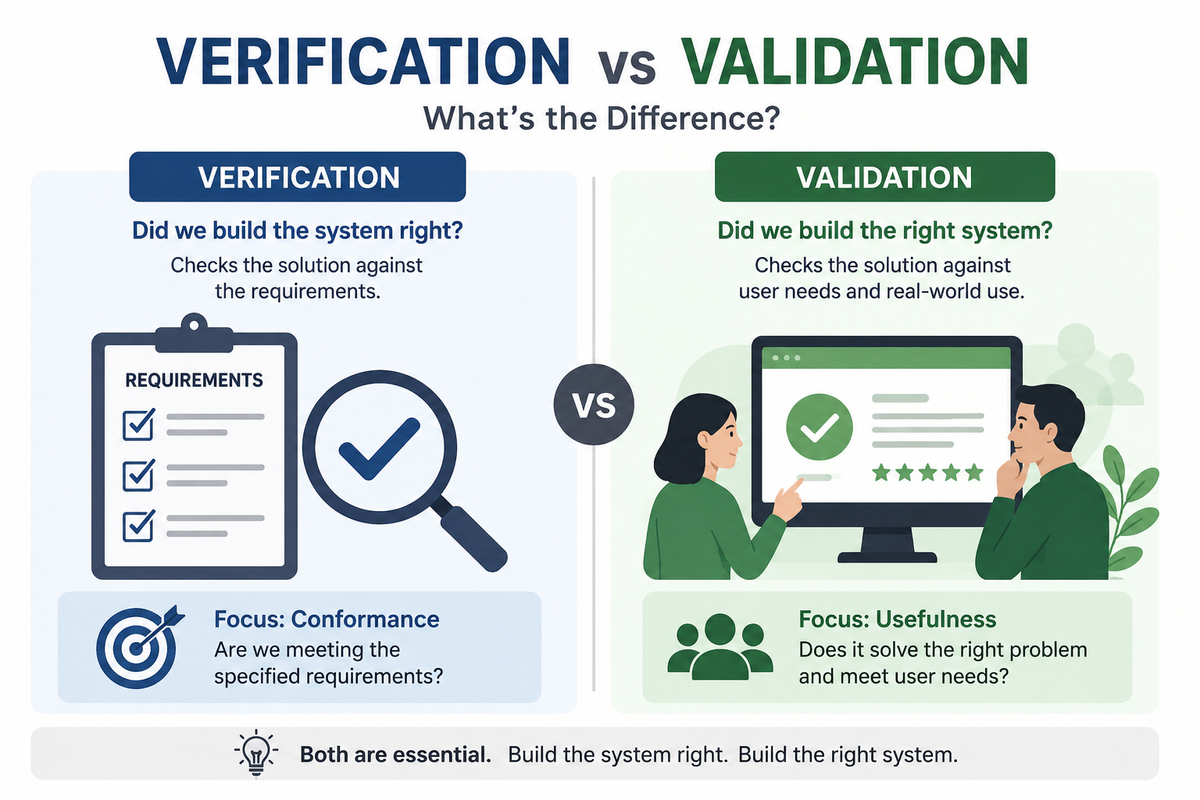
Verification and validation are often used as if they mean the same thing. They do not.
The simplest way to remember the difference is this:
Verification asks: did we build the system right?
Validation asks: did we build the right system?
That sounds simple, but in real engineering projects, the distinction is often misunderstood. Teams may test against requirements and assume the product is ready, only to discover later that users still cannot use it effectively. That is a verification success but a validation failure.
What Is Verification?
Verification is the process of proving, with objective evidence, that the system meets its specified requirements.
If a requirement says:
The payment terminal shall process a contactless card transaction in less than 3 seconds.
Verification asks:
Can we prove that the terminal actually processes the transaction in less than 3 seconds?
That proof might come from a test, inspection, analysis, or demonstration.
Verification is tied to the requirement baseline. It is about compliance with what was specified.
What Is Validation?
Validation is the process of proving that the system satisfies the stakeholder need and works for its intended use in its intended environment.
Using the same payment terminal example, validation asks:
Does this terminal actually help customers complete purchases quickly and reliably in a real retail environment?
A system could technically process payments in under 3 seconds but still fail validation if the screen is confusing, the tap area is unclear, or cashiers need too much training to recover from failed transactions.
Validation is tied to user needs, business goals, operating context, and intended use.
A Practical Example: Hospital Appointment System
Imagine a hospital develops a new appointment booking system.
A requirement says:
The system shall allow a patient to book an appointment online.
Verification checks whether the feature exists and works. Can a patient select a doctor, choose a time slot, enter personal information, and receive confirmation?
Validation asks a bigger question: does the system actually help patients book appointments successfully?
If elderly patients cannot read the interface, if the form times out too quickly, or if the available appointment categories do not match how patients describe their symptoms, the system may be verified but not validated.
It meets the written requirement. It fails the real need.
A Practical Example: Warehouse Robot
A warehouse robot may have a requirement like:
The robot shall transport packages up to 20 kg from storage zone A to packing station B.
Verification checks whether the robot can carry 20 kg and complete the route.
Validation asks whether the robot improves warehouse operations. Does it work safely around humans? Does it reduce picking delays? Does it fit through actual aisles during busy shifts? Does it integrate with the warehouse management system?
A robot can satisfy its technical requirements and still fail if it slows people down or creates new operational problems.
A Practical Example: Banking App
A banking app may include this requirement:
The app shall allow users to freeze and unfreeze their debit card.
Verification confirms that the freeze and unfreeze functions work.
Validation asks whether users can find and trust the feature during a stressful moment, such as realizing their card is missing.
If the feature is buried under five menus, the requirement may be verified, but the customer need is not truly validated.
Why Teams Confuse the Two
Teams often confuse verification and validation because both can involve testing. But the method is not what separates them. The purpose does.
A test can be used for verification if it proves compliance with a requirement. The same test, or a similar one, can support validation if it proves the system satisfies user needs in context.
The problem gets worse when requirements are vague. A requirement like:
The system shall be easy to use.
is difficult to verify and weak for validation. What does “easy” mean? Easy for whom? Under what conditions? Compared to what?
A stronger requirement might be:
A first-time user shall be able to complete account registration within 4 minutes without assistance.
That is more testable, but validation still requires asking whether account registration supports the user journey and business objective.
Verification Without Validation Is Dangerous
Verification alone can create false confidence.
A team may proudly show that every requirement passed. The traceability matrix is complete. The test report is green. The compliance evidence is ready.
But if the wrong requirements were written, the project can still fail.
This is why validation must start early. It should not wait until final delivery. Concepts, prototypes, workflows, simulations, user interviews, and operational scenarios can all support early validation.
The earlier a team asks “are we solving the right problem?”, the cheaper it is to change direction.
Where Automated Requirement Analysis Helps
Good verification and validation depend on good requirements.
If requirements are ambiguous, incomplete, inconsistent, or not verifiable, then verification becomes expensive and validation becomes uncertain. Research in requirements engineering continues to highlight ambiguity, completeness, consistency, and verifiability as key quality concerns.
This is where automated requirement quality analysis becomes valuable.
Ngenaire helps engineering teams identify weak requirements earlier by flagging issues such as vague language, missing measurable criteria, unverifiable statements, inconsistent terminology, and unclear stakeholder intent. It does not replace engineering judgment. Instead, it gives engineers faster feedback before poor requirements become expensive design, test, or validation problems.
For example, Ngenaire can help turn:
The system shall respond quickly.
into something closer to:
The system shall display the search results page within 2 seconds for 95% of standard search requests under normal operating load.
That improvement makes verification easier because the requirement is measurable. It also supports validation because the performance target can be evaluated against the actual user experience.
The Key Difference
Verification is about conformance.
Validation is about usefulness.
Verification proves that the system meets the specification.
Validation proves that the specification and resulting system meet the real need.
Strong engineering teams do both. They verify continuously against requirements and validate continuously against stakeholder intent.
Because building the system right does not matter much if you are building the wrong system.
Sources
- SEBoK, “System Verification,” definition based on ISO/IEC/IEEE 15288.
- SEBoK, “System Validation,” discussion of validation purpose, methods, and common pitfalls.
- NASA Systems Engineering Handbook, “Distinctions between Product Verification and Product Validation.”
- Requirements Engineering Magazine, “Automated Quality Assurance,” on automated requirement analysis using natural language processing.
- Montgomery et al., “Empirical research on requirements quality: a systematic mapping study,” Requirements Engineering, 2022.
- Bajceta et al., “Using NLP tools to detect ambiguities in system requirements,” NLP4RE, 2021.