
How to Conduct an Effective Design Review
Learn how to plan and conduct an effective engineering design review that identifies risks, verifies requirements, and produces clear actions.
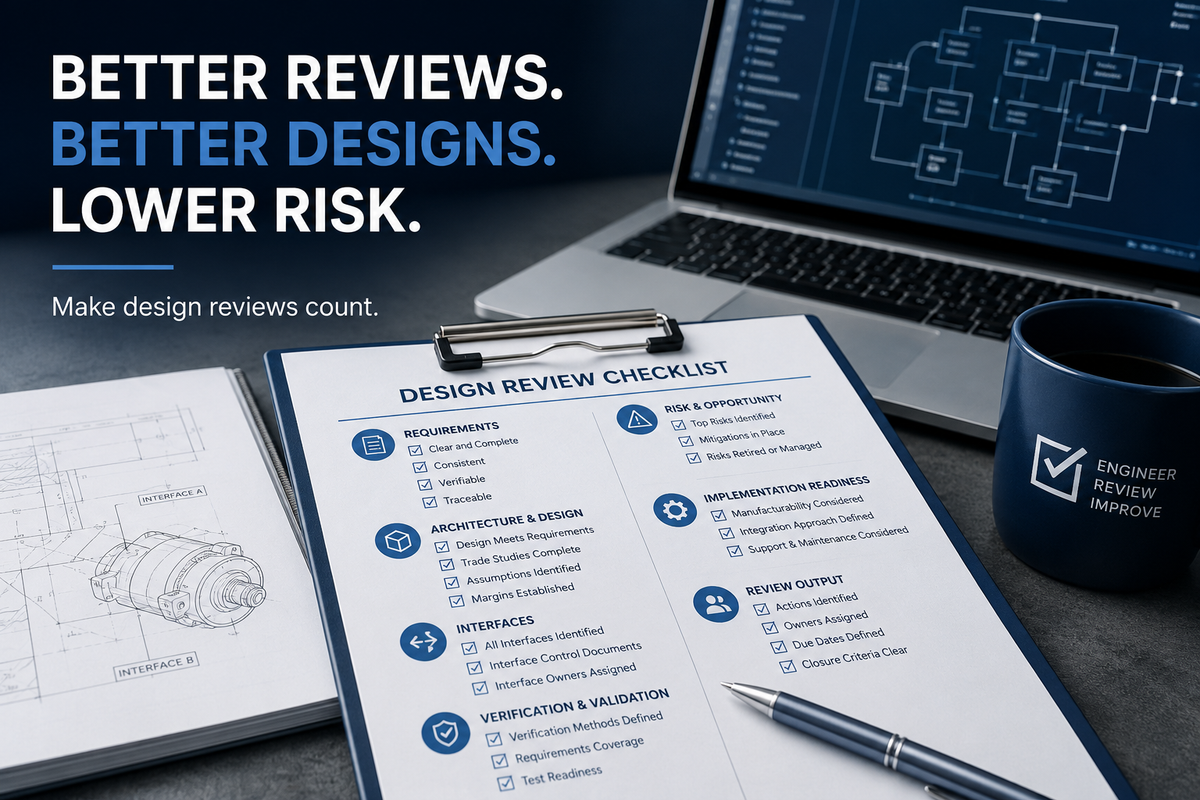
Design reviews are supposed to reduce risk. Too often, they become slide marathons. A team gathers. Everyone presents what they already built. A few people ask questions. Action items are captured. Then the project moves forward, even though the real problems were never fully exposed: unclear requirements, weak assumptions, unresolved interfaces, immature verification plans, hidden risk, or design decisions made without enough evidence. An effective design review is not a meeting. It is a technical decision gate. Its purpose is to determine whether the design is mature enough to proceed to the next phase with acceptable risk. NASA’s systems engineering guidance describes major reviews such as the Preliminary Design Review and Critical Design Review as lifecycle events with defined entrance and success criteria, not informal status updates. The DoD Systems Engineering Guidebook similarly emphasizes tailoring technical reviews, defining entrance and exit criteria, involving the right stakeholders, and closing action items before considering a review complete. The difference between a useful review and a performative review is simple: a useful review forces the design to prove itself. What Is a Design Review? A design review is a structured technical assessment of a system, subsystem, product, component, or process. It checks whether the design satisfies requirements, manages risk, respects constraints, and is ready for the next level of commitment. That commitment may be detailed design, procurement, fabrication, integration, verification, production, or release. The review should answer questions such as: - Are the requirements clear, complete, traceable, and testable? - Does the design satisfy the requirements? - Are interfaces defined and controlled? - Are assumptions visible and justified? - Are risks understood and actively managed? - Is the verification approach credible? - Are cost, schedule, manufacturability, maintainability, safety, and operational constraints being considered? - Is the design mature enough to proceed? A design review is not just about finding mistakes. It is about creating shared technical confidence. PDR: Preliminary Design Review The Preliminary Design Review, or PDR, is usually held once the team has selected a preferred design approach but before detailed design is complete. NASA defines the PDR as the point where the preliminary design should demonstrate that it meets system requirements with acceptable risk and within cost and schedule constraints, establishing the basis for proceeding into detailed design. In simpler terms, PDR asks: “Do we have the right design concept, and is it mature enough to develop in detail?” A strong PDR should show that: - The system architecture is defined. - Major design trades have been completed. - Requirements have been allocated to lower-level elements. - Interfaces have been identified. - Major risks are known and have mitigation plans. - Verification methods have been identified. - The design appears feasible within technical, cost, and schedule constraints. PDR should not require every drawing, model, test procedure, or analysis to be final. But it should prove that the team is not guessing its way into detailed design. A weak PDR often has beautiful diagrams but poor requirement flow-down, vague interface assumptions, and no credible verification strategy. CDR: Critical Design Review The Critical Design Review, or CDR, happens later. By this point, the detailed design should be mature enough to proceed into fabrication, coding, integration, or implementation. The CDR confirms that the design is stable, expected to meet performance requirements, and ready to proceed into the next major execution phase. NASA’s criteria for CDR include successful completion of prior reviews, resolution or planned closure of previous review actions, agreed success criteria, and availability of technical products for review. CDR asks: “Are we ready to build, integrate, and verify this design?” A strong CDR should show that: - The detailed design is complete enough for implementation. - Requirements are traced to design elements. - Interfaces are controlled. - Analyses support the design margins. - Verification plans, procedures, facilities, and resources are credible. - Manufacturing, integration, software, operations, maintenance, and support concerns have been considered. - Open risks are acceptable and actively managed. - Previous review actions are closed or have credible closure plans. CDR is not the time to discover that a key requirement cannot be verified, that two subsystems interpret an interface differently, or that a major design decision was never justified. That should have been caught earlier. PDR vs. CDR: The Practical Difference PDR is about design direction. CDR is about design readiness. At PDR, the team proves that the selected concept is technically sound and worth developing further. At CDR, the team proves that the developed design is mature enough to build, integrate, and verify. A useful way to think about it: Review| Main Question| Expected Evidence PDR| Are we ready for detailed design?| Architecture, trade studies, preliminary analyses, requirement allocation, interface identification, risk plan CDR| Are we ready to build and verify?| Detailed design, controlled interfaces, design analyses, verification plans, implementation readiness, closed or managed actions Both reviews depend on the same foundation: clear requirements, traceability, disciplined evidence, and honest risk assessment. What Should Be in a Design Review Checklist? A checklist should not be a bureaucratic artifact. It should be a forcing function for technical completeness. A good design review checklist should cover at least the following areas. 1. Requirements The review should confirm that requirements are clear, complete, consistent, feasible, necessary, verifiable, and traceable. Questions to ask: - Are all applicable requirements identified? - Are requirements allocated to system elements? - Are there conflicting or duplicated requirements? - Are there vague words such as “fast,” “robust,” “user-friendly,” or “as appropriate”? - Can each requirement be verified by test, analysis, inspection, or demonstration? - Are derived requirements documented and justified? - Are requirement changes controlled? This is where automated requirement analysis can help. Before a review, Ngenaire can help identify ambiguous, unverifiable, incomplete, or inconsistent requirements, giving teams a cleaner baseline before they spend hours debating design details. The goal is not to replace engineering judgment. The goal is to surface requirement quality issues early, when they are cheaper and easier to fix. 2. Architecture and Design The review should confirm that the design actually responds to the problem. Questions to ask: - Is the system architecture defined? - Are design decisions linked to requirements and constraints? - Have trade studies been documented? - Are design margins understood? - Are assumptions explicit? - Are key analyses complete enough for the review stage? - Are alternative concepts rejected for documented reasons? The danger is reviewing the design as if it appeared from nowhere. A strong review connects every major design choice back to the requirement, constraint, trade-off, or risk that drove it. 3. Interfaces Interfaces are one of the most common places where projects fail. Questions to ask: - Are internal and external interfaces identified? - Are mechanical, electrical, software, data, thermal, structural, operational, and human interfaces defined where applicable? - Are interface control documents current? - Are assumptions between teams visible? - Are interface owners assigned? - Are interface changes controlled? Many design failures are not caused by a single bad component. They are caused by two reasonable components that do not work together. 4. Verification and Validation A design is not ready if nobody knows how to prove it works. Questions to ask: - Does every requirement have a verification method? - Are verification success criteria measurable? - Are test equipment, facilities, models, simulations, or inspection methods available? - Are verification dependencies understood? - Are environmental, reliability, safety, usability, security, or regulatory verification needs included? - Are validation scenarios tied to stakeholder needs? Verification planning should not wait until after the design is finished. By then, the team may discover that the design is difficult, expensive, or impossible to verify. 5. Risk and Opportunity Reviews should expose risk, not hide it. Questions to ask: - What are the top technical risks? - What has changed since the last review? - Are risks linked to requirements, interfaces, suppliers, technologies, analyses, or verification gaps? - Are mitigations specific and owned? - Are risks being retired with evidence or only discussed repeatedly? - Are there opportunities to simplify, reuse, automate, or reduce lifecycle cost? A risk register that never changes is a warning sign. It may mean the team is tracking risks administratively rather than managing them technically. 6. Manufacturability, Integration, and Operations A design that works only in a presentation is not ready. Questions to ask: - Can the design be built, assembled, coded, integrated, inspected, and maintained? - Are long-lead items identified? - Are supplier dependencies known? - Are tolerances realistic? - Are integration steps understood? - Are operational procedures considered? - Are failure modes and maintenance needs addressed? The earlier these concerns enter the review, the fewer surprises appear downstream. 7. Action Items and Closure A review without disciplined follow-up is just a discussion. Questions to ask: - Are review findings clearly captured? - Is each action assigned to an owner? - Is there a due date? - Is the closure criterion defined? - Are major actions tracked to closure before the next gate? - Are unresolved actions reflected in risk and schedule decisions? The DoD Systems Engineering Guidebook emphasizes that review criteria should be achieved and action items closed before a technical review is considered complete. That is a useful principle for any engineering organization. Common Design Review Failure Modes Most design reviews fail in predictable ways. 1. The Review Happens Too Late If the first serious review happens after the design is effectively finished, the review becomes political. Nobody wants to reopen major decisions. The best reviews happen early enough to influence the design. 2. The Review Is Treated as a Presentation Slides are not evidence. A design review should inspect requirements, architecture, analyses, interfaces, risks, verification plans, and unresolved decisions. A polished deck can hide an immature design. 3. The Wrong People Attend A review needs the people who understand the problem, the design, the constraints, the risks, and the downstream consequences. That may include systems engineering, design engineering, software, manufacturing, test, safety, reliability, quality, operations, suppliers, customers, and users. A review made only of people from the same discipline will miss cross-functional failures. 4. Requirements Are Weak Poor requirements create poor reviews. If requirements are ambiguous, unverifiable, duplicated, conflicting, or incomplete, reviewers cannot confidently determine whether the design satisfies them. This is why requirement quality analysis should happen before the review, not during the final hour of the meeting. Ngenaire can support this by helping teams analyze requirement quality, detect ambiguity, flag unverifiable language, and improve traceability before the review package is released. That helps reviewers focus on engineering decisions instead of spending the meeting untangling basic requirement problems. 5. Interfaces Are Under-Reviewed Teams often review their own subsystem well but neglect the boundaries between subsystems. Interfaces deserve dedicated attention because they are where assumptions collide. 6. Risks Are Sanitized If every risk is green, the review is probably not honest. A productive review creates psychological safety for surfacing real risk. The point is not to punish the team. The point is to prevent expensive surprises. 7. Action Items Are Vague “Investigate issue” is not a good action item. A good action item says what needs to be resolved, who owns it, when it is due, and what evidence will prove closure. 8. Checklists Become Rituals A checklist is only useful if reviewers are willing to fail an item. If every checklist answer is “yes” by default, the checklist has become decoration. How to Make Design Reviews More Productive The best design reviews are designed before they are conducted. Define Entrance and Exit Criteria Before the review, define what must be available to enter the review and what must be true to exit it. Entrance criteria may include: - Review objectives - Agenda - Review board or reviewer list - Requirements baseline - Architecture package - Design documentation - Interface documentation - Risk register - Verification plan - Previous action item status Exit criteria may include: - Review objectives satisfied - Major risks accepted or assigned - Actions captured with owners - Required decisions made - Open issues dispositioned - Proceed, proceed with actions, or do not proceed decision recorded This keeps the review from becoming subjective. Send the Package Early A design review should not be the first time reviewers see the design. Send review material early enough for reviewers to inspect it. The live meeting should focus on decisions, risks, disagreements, and unresolved issues. Review Evidence, Not Confidence Replace “we believe this works” with “here is the evidence.” Evidence may include: - Analysis results - Models - Simulations - Test data - Trade studies - Interface definitions - Calculations - Prototypes - Verification plans - Supplier data - Lessons learned Confidence without evidence is optimism. Separate Technical Review from Status Reporting Status matters, but it should not dominate the review. A design review should focus on technical maturity and risk. Schedule and budget context are important, but they should not suppress technical concerns. Use Independent Reviewers Independent reviewers bring fresh eyes. They are less attached to the design and more likely to challenge assumptions. NASA research on engineering peer reviews found that review organization, composition, scope, execution, information technology, and structured methodologies all influence the effectiveness of reviews. Make Traceability Visible Reviewers should be able to move from stakeholder need to requirement, from requirement to design element, from design element to verification method, and from verification method to evidence. Without traceability, the review becomes opinion-based. With traceability, the review becomes evidence-based. Treat Open Issues Honestly Not every issue must be closed before proceeding. But every issue must be understood. For each open issue, ask: - What is the technical impact? - What is the likelihood? - What is the consequence? - Who owns it? - When will it be resolved? - What happens if it is not resolved? - Is it acceptable to proceed? A review can proceed with open work. It should not proceed with hidden work. The Real Purpose of a Design Review The purpose of a design review is not to approve slides. It is to protect the project from avoidable failure. A strong design review helps teams catch weak requirements, unresolved interfaces, unsupported assumptions, immature verification plans, and hidden risks before they become expensive changes. PDR helps confirm that the selected design direction is sound. CDR helps confirm that the detailed design is ready to build, integrate, and verify. Checklists help create discipline. Traceability helps create evidence. Automation helps reduce the manual burden of finding requirement and documentation issues before the review begins. That is where platforms like Ngenaire fit. By supporting requirement quality analysis, traceability, documentation consistency, and review readiness, Ngenaire helps engineering teams spend less time preparing static review artifacts and more time making better technical decisions. A good design review does not slow engineering down. It prevents the wrong design from moving fast. Sources 1. NASA, Systems Engineering Handbook, NASA/SP-2016-6105 Rev2. 2. NASA, Systems Engineering Processes and Requirements, NPR 7123.1, Appendix G Technical Review Entrance and Success Criteria. 3. NASA NPR 7123.1C, PDR and CDR entrance/success criteria. 4. Department of Defense, Systems Engineering Guidebook, 2022. 5. IEEE Std 15288.2-2014, Standard for Technical Reviews and Audits on Defense Programs. 6. ISO/IEC/IEEE 15288:2023, Systems and software engineering — System life cycle processes. 7. Chao, L. P., Tumer, I. Y., & Ishii, K., “Design Process Error-Proofing: Engineering Peer Review Lessons from NASA.” 8. Chao, L. P., “A Study of Technical Engineering Peer Reviews at NASA,” NASA Technical Reports Server. 9. The Aerospace Corporation, Guidelines for Space Systems Critical Gated Events. 10. Argonne National Laboratory, Design Review Checklist Example.