
The Systems Engineering Lifecycle Explained
Understand the systems engineering lifecycle, from stakeholder needs and requirements through design, integration, verification, and validation.
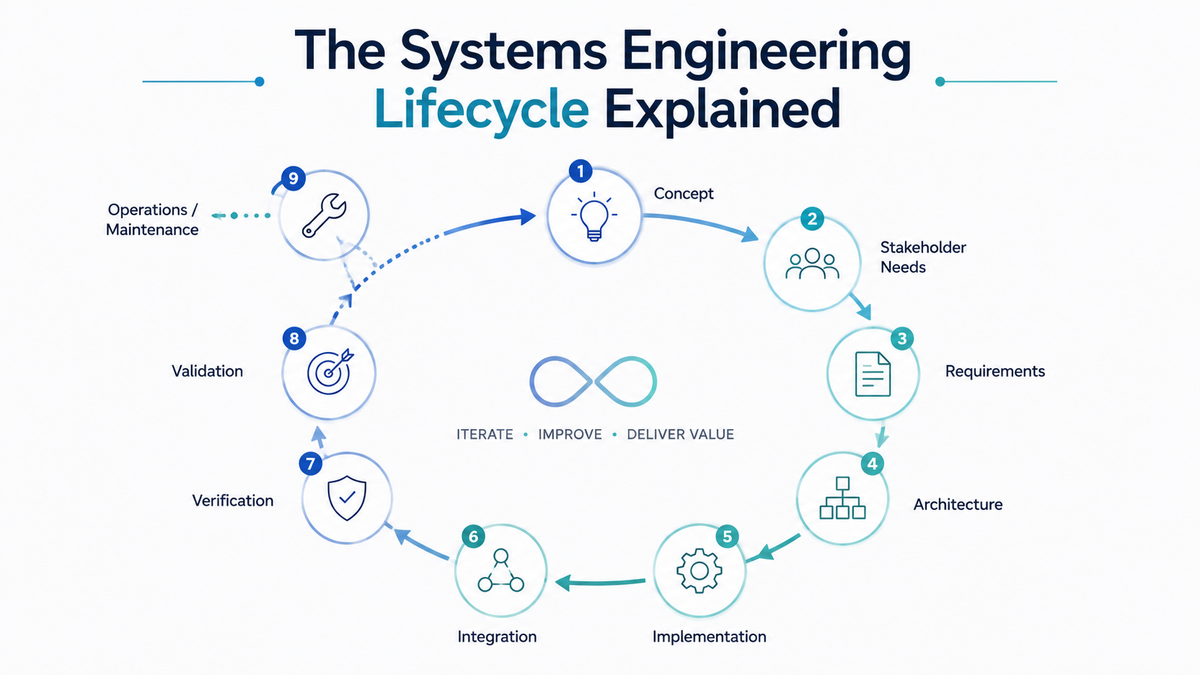
Complex products rarely fail because one engineer did one calculation incorrectly. More often, they fail because the problem was misunderstood, requirements were incomplete, interfaces were missed, verification was delayed, stakeholders were misaligned, or lifecycle costs were ignored until too late.
That is why the systems engineering lifecycle matters.
The systems engineering lifecycle is the structured way engineers move from a need or opportunity to a delivered, verified, operated, maintained, and eventually retired system. It helps teams think beyond “design and build” and consider the full journey of a system: why it exists, who it serves, what it must do, how it will be proven, how it will be supported, and how it will evolve.
For modern engineering organizations, this lifecycle is not just a process chart. It is a way to reduce risk, control complexity, improve communication, and build systems that actually solve the problem they were created to solve.
What Is the Systems Engineering Lifecycle?
The systems engineering lifecycle is the set of phases, activities, decisions, and feedback loops used to guide a system from concept to retirement.
A “system” can be a physical product, software platform, manufacturing process, medical device, energy system, transportation service, industrial machine, or digital product. What makes it a system is not its size, but the fact that it contains interacting parts that must work together to achieve a purpose.
In simple terms, the lifecycle asks:
- What problem are we solving?
- Who needs the system and why?
- What outcomes must the system achieve?
- What functions and requirements are needed?
- What architecture best satisfies those requirements?
- How will the system be implemented?
- How will we verify that it was built correctly?
- How will we validate that it solves the real problem?
- How will it be operated, maintained, upgraded, and retired?
The lifecycle exists because engineering decisions made early often determine cost, performance, safety, usability, supportability, and long-term business success.
A Brief History of the System Development Lifecycle
The idea of organizing engineering work into lifecycle stages did not appear all at once. It developed over decades as systems became more complex and failures became more expensive.
Early Engineering and Industrial Foundations
Before the formal language of “systems engineering” became common, industries already used staged development practices. Large infrastructure, manufacturing, telecommunications, defense, transportation, and industrial control systems required planning, design reviews, integration, testing, and maintenance.
As projects grew in scale, organizations realized that success depended not only on technical design, but also on coordination between disciplines. Mechanical, electrical, software, human factors, operations, quality, procurement, and customer needs all had to be managed together.
This gave rise to systems thinking: the idea that the whole system must be understood as more than the sum of its parts.
The Rise of Systems Engineering
Systems engineering began to emerge as a recognizable discipline in the mid-20th century. Organizations working on highly complex technical programs needed a more rigorous way to manage interfaces, requirements, trade-offs, verification, and integration.
Key contributors included researchers and practitioners in operations research, control theory, management science, telecommunications, and large-scale engineering programs. Bell Labs is often associated with early systems engineering practice, especially because telecommunications networks required end-to-end thinking across hardware, software, users, operations, and maintainability.
Over time, systems engineering became less tied to any one industry. It became a general discipline for developing complex systems in sectors such as automotive, healthcare, rail, energy, software-intensive products, robotics, consumer electronics, manufacturing, and enterprise technology.
The Software Development Lifecycle and the Waterfall Debate
The system development lifecycle is closely related to the software development lifecycle, often called the SDLC. In software, lifecycle thinking became prominent because large software projects were increasingly difficult to plan, build, and test.
One of the most cited historical papers is Winston W. Royce’s 1970 paper, Managing the Development of Large Software Systems. Royce is often associated with the “waterfall model,” although his actual paper was more nuanced than the simple waterfall diagrams that later became popular. He described a sequential flow from requirements through design, coding, testing, and operations, but he also warned that a purely linear process could be risky without feedback, prototyping, and iteration.
This is important because many people criticize “waterfall” as if Royce advocated a rigid one-pass process. In reality, his paper helped start an important conversation: development needs structure, but structure without feedback can create late discovery of problems.
The Spiral Model and Risk-Driven Development
In 1988, Barry Boehm introduced the spiral model of software development. This was a major shift because it treated development as iterative and risk-driven.
Instead of assuming that all requirements and designs could be completed perfectly upfront, the spiral model encouraged teams to identify risks, prototype, evaluate alternatives, and refine the system through repeated cycles.
This idea remains deeply relevant to systems engineering. Modern systems are often too complex, uncertain, and software-intensive to be developed as a single straight line. Risk, learning, stakeholder feedback, and iteration must be built into the lifecycle.
Standards and Professionalization
As systems engineering matured, professional organizations and standards bodies helped formalize lifecycle processes.
Important players include:
- INCOSE, the International Council on Systems Engineering, which has helped define and advance systems engineering practice globally.
- ISO, IEC, and IEEE, which have produced lifecycle standards such as ISO/IEC/IEEE 15288 for system life cycle processes.
- EIA, whose earlier systems engineering process standards influenced later lifecycle frameworks.
- Barry Boehm, known for the spiral model and software engineering economics.
- Winston Royce, whose 1970 paper influenced decades of lifecycle thinking in software development.
- W. Edwards Deming, whose quality and continuous improvement principles influenced engineering process thinking more broadly.
- Peter Checkland, known for soft systems methodology, which emphasized understanding human, organizational, and problem-context complexity.
- Derek Hitchins, Alexander Kossiakoff, William Sweet, Harold Chestnut, and others who contributed to systems engineering theory, education, and practice.
Today, lifecycle thinking is reflected in standards, handbooks, MBSE methods, agile systems engineering approaches, digital engineering, product development processes, and enterprise engineering frameworks.
The Main Stages of the Systems Engineering Lifecycle
Different organizations use different names for lifecycle stages, but the core logic is usually similar.
A practical lifecycle can be described as:
- Concept and need identification
- Stakeholder needs and requirements
- System requirements definition
- Architecture and design
- Implementation
- Integration
- Verification
- Validation
- Operation and maintenance
- Upgrade, evolution, and retirement
These stages should not be treated as a rigid one-way sequence. In real projects, teams often iterate between them.
1. Concept and Need Identification
Every system starts with a need, opportunity, problem, or mission.
This stage answers questions such as:
- What problem are we solving?
- Who experiences this problem?
- Why does it matter?
- What is the business, operational, or user value?
- What happens if we do nothing?
- What constraints already exist?
This is where teams should avoid jumping too quickly to a solution. A poor concept definition can cause the entire project to optimize around the wrong problem.
For example, a company may think it needs “a new dashboard,” but the actual need may be faster decision-making, better data quality, reduced operator workload, or improved traceability. The dashboard is only one possible solution.
Good systems engineering starts by separating the need from the solution.
2. Stakeholder Needs and Requirements
Once the problem is understood, the next step is identifying stakeholders and their needs.
Stakeholders may include:
- End users
- Customers
- Operators
- Maintainers
- Manufacturers
- Regulators
- Safety teams
- Security teams
- Business leaders
- Support teams
- Suppliers
- Integration partners
Each stakeholder may care about different things. Users may care about usability. Maintainers may care about diagnostics. Business leaders may care about cost and time to market. Regulators may care about compliance. Security teams may care about access control and data protection.
The goal is to capture needs clearly before translating them into technical requirements.
Poor stakeholder analysis often leads to systems that technically work but fail in real use.
3. System Requirements Definition
Requirements translate stakeholder needs into clear, testable statements about what the system must do and how well it must perform.
Good requirements should be:
- Clear
- Necessary
- Feasible
- Verifiable
- Traceable
- Unambiguous
- Consistent
- Design-independent where possible
This stage is one of the most important parts of the lifecycle because requirements become the foundation for architecture, design, verification, validation, cost estimates, schedules, supplier agreements, and acceptance criteria.
A vague requirement such as:
The system shall be user-friendly.
is difficult to verify.
A stronger version would define measurable usability expectations, such as task completion time, error rates, accessibility needs, or training time.
This is also where structured methods such as EARS, requirement templates, traceability matrices, and model-based systems engineering can help improve consistency.
4. Architecture and Design
Architecture describes how the system will be organized to meet its requirements.
This includes:
- System functions
- Major components
- Interfaces
- Data flows
- Physical structure
- Logical structure
- Allocation of requirements
- Trade studies
- Technology decisions
- Make-buy decisions
- Safety and security considerations
- Performance budgets
Architecture is where complexity becomes visible.
A good architecture shows how the system fits together. It helps teams identify interfaces, dependencies, risks, and design trade-offs before implementation begins.
For example, in a software-enabled industrial product, architecture may define how sensors, embedded controllers, cloud services, user interfaces, databases, and maintenance tools interact. Without architecture, each team may optimize locally while the overall system becomes fragile.
Architecture is also where MBSE can provide major value. Instead of relying only on documents, teams can use models to represent structure, behavior, interfaces, requirements, and verification relationships.
5. Implementation
Implementation is where the system is built.
Depending on the system, this may include:
- Software development
- Mechanical design
- Electrical design
- Hardware fabrication
- Supplier development
- Database configuration
- Manufacturing process setup
- User interface development
- Algorithm development
- Documentation
- Tooling
- Test equipment
Implementation is often where organizations spend most of their visible effort, but it should not be disconnected from the earlier lifecycle stages.
Every implementation decision should trace back to requirements, architecture, constraints, and verification plans.
When teams skip lifecycle discipline, implementation becomes reactive. Engineers build features, discover conflicts late, redesign interfaces, and struggle to prove compliance.
6. Integration
Integration is where system elements are brought together.
This is one of the most difficult lifecycle stages because components that work individually may not work together.
Integration issues often appear in:
- Interfaces
- Timing
- Data formats
- Mechanical fit
- Electrical compatibility
- Network behavior
- Software dependencies
- Environmental constraints
- Human-machine interaction
- Supplier-delivered components
- Configuration mismatches
A strong systems engineering lifecycle plans integration early. Integration should not be treated as a final assembly event. It should be incremental, risk-based, and supported by interface control.
The earlier teams test interfaces, the less painful integration becomes.
7. Verification
Verification answers the question:
Did we build the system right?
It checks whether the system satisfies its specified requirements.
Verification methods may include:
- Inspection
- Analysis
- Demonstration
- Test
For example, if a requirement states that a system must process a transaction within two seconds under a defined load, verification confirms whether that requirement is met.
Verification should be planned when requirements are written, not after the system is built. Every requirement should have a verification method and acceptance criteria.
A requirement that cannot be verified is not ready.
8. Validation
Validation answers a different question:
Did we build the right system?
A system can pass verification and still fail validation.
For example, a product may meet every written requirement but still be too difficult for users, too expensive to support, too slow for real workflows, or poorly aligned with the original business need.
Validation checks whether the system solves the real stakeholder problem in the intended context.
This may involve:
- User trials
- Operational evaluations
- Pilot deployments
- Field feedback
- Scenario-based assessment
- Business outcome review
- Human factors evaluation
Verification compares the system against requirements. Validation compares the system against real needs.
Both are essential.
9. Operation and Maintenance
The lifecycle does not end at delivery.
Once a system is deployed, it enters operation and maintenance. This is where the system creates value, but it is also where long-term costs appear.
Important concerns include:
- Reliability
- Maintainability
- Availability
- Supportability
- Cybersecurity updates
- User training
- Spare parts
- Monitoring
- Incident response
- Configuration management
- Obsolescence management
- Performance in real operating conditions
Many lifecycle costs occur after initial development. A system that is cheap to build but expensive to maintain may not be successful.
Systems engineering encourages teams to consider operations and support from the beginning.
10. Upgrade, Evolution, and Retirement
Systems change over time.
Users discover new needs. Technology evolves. Regulations change. Suppliers discontinue parts. Security threats appear. Competitors improve. Business models shift.
A good lifecycle includes controlled evolution.
This involves:
- Change impact analysis
- Configuration management
- Regression testing
- Requirements updates
- Architecture updates
- Version control
- Migration planning
- End-of-life planning
Eventually, every system must be retired, replaced, decommissioned, recycled, archived, or migrated.
Retirement should be planned responsibly, especially when systems contain sensitive data, safety implications, environmental concerns, or long-term support obligations.
Lifecycle Models: Waterfall, V-Model, Spiral, Agile, and Hybrid
There is no single lifecycle model that works for every system.
Different projects need different levels of structure, iteration, documentation, speed, and control.
Waterfall
The waterfall model is a sequential lifecycle model where phases flow from requirements to design, implementation, testing, and operations.
It can be useful when requirements are stable, the technology is well understood, and regulatory documentation is important. However, it can be risky when uncertainty is high because problems may be discovered late.
V-Model
The V-model emphasizes the relationship between development and verification.
On the left side, teams define needs, requirements, architecture, and design. On the right side, they verify and validate against those definitions.
The V-model is useful because it reminds teams that test planning should happen early. Requirements and verification are connected.
Spiral Model
The spiral model is iterative and risk-driven. Teams cycle through objectives, risk analysis, prototyping, development, and evaluation.
It is useful when uncertainty is high and learning is required.
Agile and Incremental Development
Agile approaches emphasize short development cycles, frequent feedback, working increments, and adaptability.
Agile can be powerful for software-intensive systems, but it still needs systems engineering discipline. Agile teams still need architecture, requirements, interfaces, verification, validation, configuration management, and stakeholder alignment.
Hybrid Lifecycles
Many real organizations use hybrid approaches.
For example, hardware development may require longer lead times and formal design reviews, while software may be developed iteratively. A hybrid lifecycle allows teams to combine structure with adaptability.
The best lifecycle is not the one with the trendiest name. It is the one that fits the risk, complexity, uncertainty, regulatory environment, stakeholder needs, and business context of the system.
Why the Systems Engineering Lifecycle Matters
The lifecycle helps teams avoid common failure modes.
1. It reduces late rework
Problems found during concept, requirements, or architecture are usually cheaper to fix than problems found during integration or operation.
2. It improves communication
A lifecycle creates shared language between engineering, product, business, suppliers, quality, operations, and customers.
3. It connects requirements to verification
Traceability ensures that requirements are not just written, but also designed, implemented, verified, and validated.
4. It manages complexity
As systems grow, no single person can hold every detail in their head. Lifecycle processes help organize complexity.
5. It supports better decisions
Trade studies, architecture reviews, risk analysis, and lifecycle cost thinking help teams make decisions based on evidence, not assumptions.
6. It improves product-market fit
Validation ensures the system solves the real problem, not just the documented one.
7. It supports long-term sustainability
Operation, maintenance, upgrade, and retirement planning prevent teams from treating delivery as the finish line.
Common Mistakes in Applying the Lifecycle
The lifecycle is powerful, but it can be misused.
Mistake 1: Treating the lifecycle as paperwork
The lifecycle should help teams think, decide, and communicate. If it becomes documentation for its own sake, it loses value.
Mistake 2: Freezing requirements too early
Requirements need discipline, but early assumptions should be tested. A good lifecycle allows learning and controlled change.
Mistake 3: Delaying verification planning
If verification is not considered when requirements are written, teams may later discover that key requirements are impossible or expensive to test.
Mistake 4: Ignoring interfaces
Many system failures occur at interfaces between components, teams, suppliers, or organizations.
Mistake 5: Confusing verification with validation
A system can satisfy requirements and still disappoint users. Verification and validation must both be planned.
Mistake 6: Forgetting operations and maintenance
A system that is difficult to support may become a business liability even if the initial launch succeeds.
The Modern Lifecycle: Digital, Model-Based, and AI-Assisted
The systems engineering lifecycle is evolving.
Modern engineering teams increasingly use:
- Model-Based Systems Engineering
- Digital engineering environments
- Requirements management tools
- Simulation
- Digital twins
- Automated traceability
- Continuous integration and testing
- AI-assisted requirements generation
- Automated document review
- Configuration-controlled engineering data
- Collaborative engineering platforms
The goal is not to replace engineers. The goal is to reduce manual busy work, improve consistency, expose gaps earlier, and help teams make better decisions.
For example, AI can help draft requirements, identify ambiguity, suggest missing verification methods, detect duplicate requirements, and improve traceability. But human engineering judgment remains essential. AI can accelerate the lifecycle, but engineers remain responsible for context, correctness, trade-offs, and accountability.
This is where tools like Ngenaire can help. By supporting engineers in requirements writing, lifecycle thinking, and structured engineering workflows, Ngenaire aims to reduce repetitive work and help teams focus on higher-value engineering decisions.
Final Thoughts
The systems engineering lifecycle is not just a process diagram. It is a disciplined way to think about complexity.
It helps engineers move from problem to solution while maintaining alignment between stakeholder needs, requirements, architecture, implementation, verification, validation, operation, and retirement.
The history of lifecycle thinking shows an important lesson: structure matters, but so does feedback. Purely linear development can hide risk. Purely unstructured iteration can create chaos. The best engineering organizations combine discipline with learning.
A strong lifecycle does not slow innovation. It makes innovation more reliable.
For teams building complex products, the question is not whether they have a lifecycle. They already do, even if it is informal.
The real question is whether their lifecycle helps them discover problems early, make better decisions, and deliver systems that work in the real world.
Sources
Boehm, B. W. (1988). A spiral model of software development and enhancement. Computer, 21(5), 61–72.
Checkland, P. (1981). Systems Thinking, Systems Practice. John Wiley & Sons.
Deming, W. E. (1986). Out of the Crisis. MIT Press.
INCOSE. (2023). Systems Engineering Handbook: A Guide for System Life Cycle Processes and Activities (5th ed.). Wiley.
ISO/IEC/IEEE. (2023). ISO/IEC/IEEE 15288:2023 Systems and software engineering — System life cycle processes.
Kossiakoff, A., Sweet, W. N., Seymour, S. J., & Biemer, S. M. (2011). Systems Engineering Principles and Practice (2nd ed.). Wiley.
Royce, W. W. (1970). Managing the Development of Large Software Systems. Proceedings of IEEE WESCON.
Sage, A. P., & Rouse, W. B. (Eds.). (2009). Handbook of Systems Engineering and Management (2nd ed.). Wiley.
Sommerville, I. (2015). Software Engineering (10th ed.). Pearson.
Walden, D. D., Roedler, G. J., Forsberg, K. J., Hamelin, R. D., & Shortell, T. M. (Eds.). (2015). Systems Engineering Handbook: A Guide for System Life Cycle Processes and Activities (4th ed.). Wiley.