
There Is More to Controls Than PID
Explore control strategies beyond PID, including feedforward, state-space, model predictive, adaptive, and robust control for complex systems.
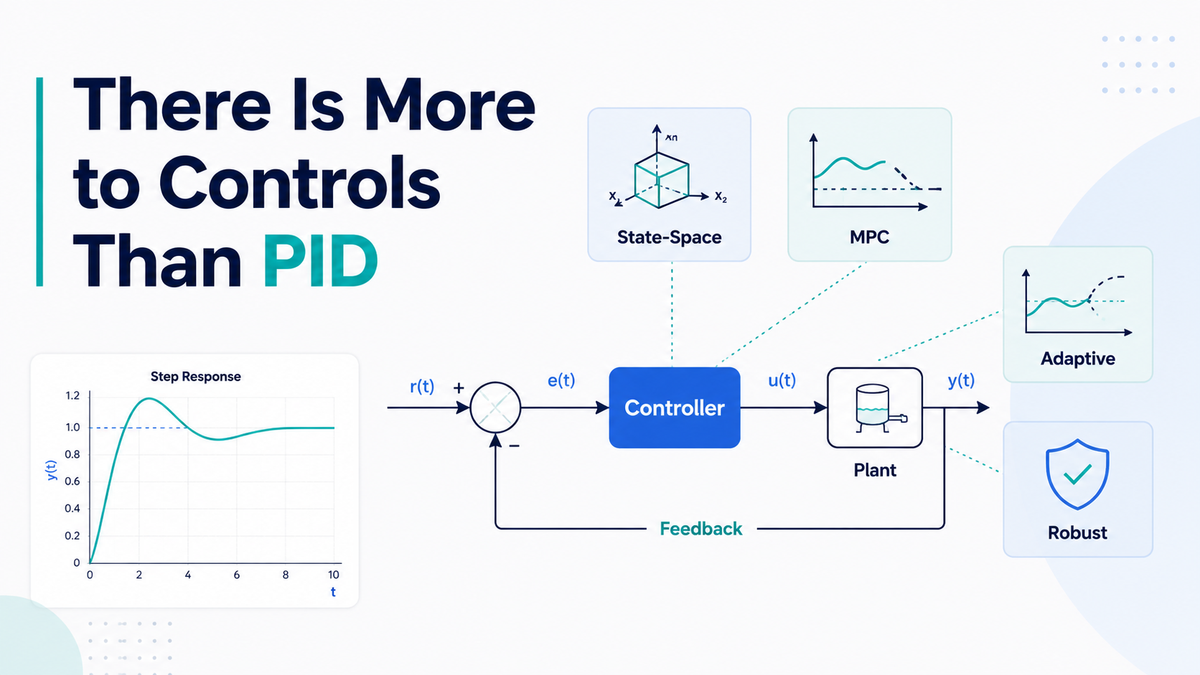
When engineers first learn control systems, they often meet three letters very early: PID. Proportional. Integral. Derivative. PID control is everywhere. It regulates temperature in industrial ovens, maintains pressure in process plants, controls motor speed in manufacturing equipment, stabilizes power converters, manages fluid levels in tanks, and appears in countless embedded systems. It is simple, practical, explainable, and surprisingly powerful. But PID is not the whole field of control engineering. It is one of the most successful control methods ever developed, but it is also only one tool in a much larger toolbox. As systems become more complex, software-driven, constrained, nonlinear, networked, and adaptive, engineers need to understand when PID is enough — and when it is not. What Is a Control System? A control system is a system that influences the behavior of another system to achieve a desired outcome. At its simplest, a control system compares what you want with what you have, then makes an adjustment. For example: - A thermostat compares the desired room temperature with the measured room temperature. - A motor controller compares desired speed with measured speed. - A water tank controller compares desired level with measured level. - A manufacturing process controller compares desired pressure, flow, or temperature with measured process values. Most practical control systems involve four basic ideas: 1. Reference input — the desired target or setpoint. 2. Sensor measurement — what the system is actually doing. 3. Controller — the logic that decides what correction is needed. 4. Actuator — the device that applies the correction. In a closed-loop control system, feedback is used to continuously reduce error between the desired behavior and the measured behavior. This feedback idea is one of the most important concepts in engineering. A Brief History of Feedback Control The idea of automatic control is much older than modern electronics or software. Ancient water clocks used float mechanisms to regulate water flow and maintain timekeeping accuracy. Later, mechanical governors were used to regulate the speed of machines. One of the most famous early examples is the centrifugal governor, commonly associated with James Watt and the steam engine era. The governor automatically adjusted steam flow to help regulate engine speed. This was not just a mechanical invention; it was a major step toward the modern concept of feedback control. In 1868, James Clerk Maxwell published “On Governors,” one of the foundational mathematical works in control theory. Maxwell analyzed the stability of governors and showed that feedback systems could oscillate or become unstable if not properly designed. This helped shift control from craft knowledge toward mathematical engineering. Later contributors such as Edward Routh and Adolf Hurwitz developed stability criteria that allowed engineers to reason about whether a system would remain stable. In the 20th century, figures such as Harry Nyquist, Hendrik Bode, Norbert Wiener, and Rudolf Kalman helped shape frequency-domain control, cybernetics, estimation theory, and modern state-space control. Control engineering grew from mechanical regulators into a rigorous discipline spanning mathematics, electronics, computation, optimization, and software. The Rise of PID Control PID control became one of the most widely used control methods because it is intuitive and practical. A PID controller calculates a control action using three terms: - Proportional control responds to the current error. - **Integral control responds to accumulated past error. - **Derivative control responds to the predicted trend of the error. Each term solves a different problem. The proportional term gives an immediate correction. The integral term helps eliminate steady-state error. The derivative term helps dampen the response and anticipate change. One of the key historical figures in PID development was Nicolas Minorsky. In the early 1920s, Minorsky studied automatic steering systems for ships. His work connected control action to the observed behavior of human operators and helped formalize the use of proportional, integral, and derivative terms. Another major milestone came in 1942, when John G. Ziegler and Nathaniel B. Nichols published their famous paper, “Optimum Settings for Automatic Controllers.” Their tuning rules gave engineers a practical way to set controller gains using experimental response data. The Ziegler-Nichols method became deeply influential in industrial control because it made PID tuning accessible and repeatable. PID succeeded because it fit the needs of industrial engineering: - It was easy to implement with analog hardware. - It was later easy to implement in digital controllers. - It worked well for many single-input, single-output systems. - It did not require a highly detailed mathematical model. - Operators and engineers could understand its behavior. That combination made PID a workhorse of automation. Why PID Is Still Everywhere PID remains popular because many real engineering problems do not require advanced control theory. If the system is reasonably linear near its operating point, has one main input and one main output, and does not have severe constraints or delays, PID may be good enough. A temperature loop, pump speed loop, tank level loop, or simple motor speed loop may not need an advanced controller. In these cases, PID is attractive because it is simple, low-cost, and robust enough for practical use. PID also has a major organizational advantage: engineers, technicians, and operators know it. It is easy to document, troubleshoot, tune, and maintain. In engineering, the best solution is not always the most mathematically advanced one. The best solution is the one that meets the requirement reliably, safely, and economically. Sometimes that solution is PID. But not always. The Limits of PID PID control starts to struggle when systems become more complex. For example, PID may not be ideal when: - The system has multiple interacting inputs and outputs. - The system has strong nonlinear behavior. - The system has time delays. - The system has actuator limits or safety constraints. - The system must optimize performance while respecting constraints. - The operating conditions change significantly over time. - The system needs to predict future behavior. - The controller must coordinate many variables at once. A PID controller is reactive. It responds to error. It does not inherently understand the physical model of the system, future constraints, or trade-offs between competing objectives. That does not make PID bad. It means PID has a scope. A good controls engineer does not ask, “Can I use PID for this?” A better question is: What control strategy best matches the system dynamics, requirements, risks, and constraints? Similar and Related Control Schemes PID belongs to a family of classical feedback control methods. Some related approaches include: On-Off Control This is one of the simplest control methods. The actuator is either fully on or fully off. A basic thermostat is a common example. If the temperature is too low, heating turns on. If the temperature is high enough, heating turns off. On-off control is simple and inexpensive, but it can cause cycling and may not provide smooth control. Proportional Control Proportional control uses only the current error. The larger the error, the larger the correction. This is simpler than PID, but it can leave steady-state error. For example, a system may settle slightly below or above the desired target because some persistent error is needed to generate the correction. PI Control PI control combines proportional and integral action. It is widely used when steady-state accuracy matters but derivative action is unnecessary or too noisy. Many industrial loops use PI rather than full PID because derivative action can amplify measurement noise if not carefully filtered. PD Control PD control combines proportional and derivative action. It can improve damping and response speed, but it does not eliminate steady-state error by itself. PD control is useful in systems where anticipating motion or change is important, but where integral action may create instability or overshoot. Feedforward Control Feedback control reacts to error after it appears. Feedforward control acts before the error develops. For example, if a system knows that a disturbance is about to occur, it can compensate in advance. Feedforward is often combined with feedback. The feedforward path handles predictable effects, while feedback corrects remaining error. Cascade Control Cascade control uses one control loop inside another. The inner loop controls a fast variable, while the outer loop controls a slower higher-level variable. This can improve disturbance rejection and performance in process control, motor control, and thermal systems. Ratio Control Ratio control maintains a fixed relationship between two variables, such as flow rates in a mixing process. This is common in chemical processing, fuel-air control, and manufacturing operations. Lead-Lag Compensation Lead and lag compensators are classical control tools used to shape system response. They can improve stability margins, transient response, and steady-state accuracy. These methods are closely related to frequency-domain control and are often designed using Bode plots, root locus, or frequency response methods. Beyond PID: Modern Control Methods As systems become more software-defined, engineers often need control strategies that go beyond PID. State-Space Control State-space control represents a system using internal state variables. Instead of controlling only based on input-output error, the controller can use a model of the system’s internal behavior. This approach became especially important in modern control theory. It supports multi-variable systems and provides a foundation for advanced methods such as optimal control and observers. Observers and State Estimators Sometimes not every important variable can be measured directly. An observer estimates hidden system states using available measurements and a system model. The Kalman filter, introduced by Rudolf Kalman, became one of the most important tools for estimation in noisy systems. It is widely used wherever systems must estimate state from imperfect measurements. Optimal Control Optimal control asks: what control action minimizes a cost function? The cost might include tracking error, energy use, actuator effort, time, or other performance objectives. This is useful when engineering trade-offs must be explicitly balanced. Model Predictive Control Model Predictive Control, or MPC, uses a model of the system to predict future behavior over a time horizon. It then solves an optimization problem to choose the best control action while respecting constraints. MPC is powerful because it can handle: - Multiple inputs and outputs. - Actuator limits. - Safety constraints. - Process constraints. - Future predicted behavior. - Optimization objectives. This makes MPC valuable in process control, energy systems, robotics, advanced manufacturing, and other complex engineering applications. Adaptive Control Adaptive control changes controller parameters as the system changes. This is useful when the system dynamics are uncertain or vary over time. Instead of using fixed gains forever, adaptive control attempts to update the controller based on observed behavior. Robust Control Robust control is designed to maintain performance even when the system model is imperfect. It explicitly considers uncertainty. This is important because real systems rarely match mathematical models perfectly. Components age, environments change, loads vary, and sensors contain noise. Learning-Based and AI-Assisted Control AI and machine learning are increasingly being explored for control applications, especially where systems are difficult to model. Learning-based control can help identify patterns, tune parameters, or support decision-making. However, AI-based control must be treated carefully. Safety, explainability, validation, and robustness matter. In engineering systems, a controller cannot simply be clever; it must be trustworthy. Choosing the Right Controller The right control strategy depends on the system and the requirement. PID may be the best choice when the system is simple, well-behaved, and easy to tune. MPC may be better when constraints and multivariable interactions dominate. Robust control may be needed when uncertainty is the main concern. Adaptive control may be useful when the system changes over time. Feedforward may be ideal when disturbances are measurable before they affect the output. A practical controls engineer thinks about questions such as: - What are we trying to control? - What can we measure? - What can we actuate? - How fast does the system respond? - Is the system linear or nonlinear? - Are there delays? - Are there constraints? - What happens if the controller performs poorly? - Does the system need to optimize, stabilize, track, reject disturbances, or all of these? - How will the controller be tested, validated, and maintained? Control design is not just about selecting an algorithm. It is about understanding the system. Why This Matters for Engineers There is more to controls than PID because there is more to engineering than making a number reach a setpoint. Modern engineered systems are increasingly connected, autonomous, software-defined, and data-rich. They must operate under constraints, uncertainty, and changing conditions. They often involve multiple subsystems interacting with each other. In that world, PID remains important, but it is not enough by itself. Engineers need to understand the broader control landscape because different problems demand different approaches. A simple controller can be elegant when the problem is simple. An advanced controller can be necessary when the problem is complex. The real skill is knowing the difference. PID deserves its reputation. It is one of the most practical and enduring ideas in engineering. But it should be seen as the beginning of control thinking, not the end. The best controls engineers do not worship PID, and they do not dismiss it either. They understand it, respect it, and know when to move beyond it. Key Takeaway PID is powerful because it is simple, practical, and effective for many real systems. But control engineering is much bigger than PID. From feedback governors and classical stability theory to state-space control, Kalman filtering, robust control, adaptive control, and model predictive control, the field of controls is really about one thing: Designing systems that behave predictably, safely, and intelligently in the real world. Scholarly Sources and Further Reading 1. Maxwell, J. C. (1868). “On Governors.” Proceedings of the Royal Society of London, 16, 270–283. 2. Minorsky, N. (1922). “Directional Stability of Automatically Steered Bodies.” Journal of the American Society for Naval Engineers, 34(2), 280–309. 3. Ziegler, J. G., & Nichols, N. B. (1942). “Optimum Settings for Automatic Controllers.” Transactions of the ASME, 64, 759–768. 4. Bennett, S. (1996). “A Brief History of Automatic Control.” IEEE Control Systems Magazine, 16(3), 17–25. 5. Åström, K. J., & Hägglund, T. (2006). Advanced PID Control. ISA — The Instrumentation, Systems, and Automation Society. 6. Ogata, K. (2010). Modern Control Engineering fifth edition. Prentice Hall. 7. Franklin, G. F., Powell, J. D., & Emami-Naeini, A. (2015). Feedback Control of Dynamic Systems seventh edition. Pearson. 8. Kalman, R. E. (1960). “A New Approach to Linear Filtering and Prediction Problems.” Transactions of the ASME — Journal of Basic Engineering, 82(1), 35–45. 9. Rawlings, J. B., Mayne, D. Q., & Diehl, M. (2017). Model Predictive Control: Theory, Computation, and Design second edition. Nob Hill Publishing. 10. Skogestad, S., & Postlethwaite, I. (2005). Multivariable Feedback Control: Analysis and Design second edition. Wiley.