
What Is a Digital Twin and Why Should Engineers Care?
Learn how digital twins connect models, real-world data, simulation, and operations to improve engineering decisions across the system lifecycle.
Engineering has always relied on models.
Before a product is built, engineers create drawings, simulations, requirements, prototypes, analyses, test plans, and verification reports. These artifacts help teams understand how a system should behave before money is spent building it.
But there is a problem.
Most engineering models are disconnected from the real thing.
A CAD model may describe geometry. A simulation may predict performance. A requirements document may define expected behavior. A test report may show what happened at one point in time. A maintenance log may record what failed later.
Each artifact is useful, but each is usually only a partial view.
A digital twin tries to connect these pieces.
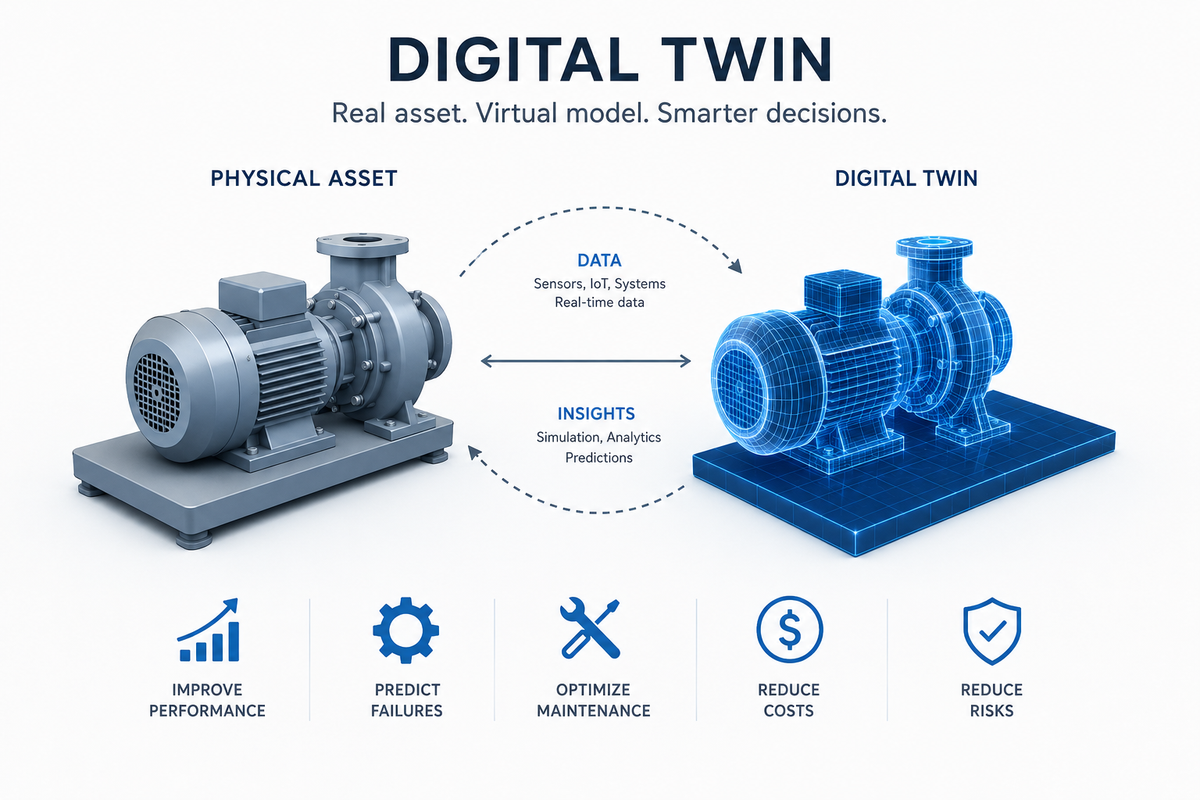
At its simplest, a digital twin is a living digital representation of a physical product, process, system, or asset. It is not just a static 3D model. It is a model that is connected to real-world data, updated over time, and used to understand, predict, improve, or control the physical thing it represents.
For engineers, that matters because it changes the role of models from “design-time documentation” to “life-cycle intelligence.”
A Simple Definition
A digital twin is a digital model of a physical system that is continuously or periodically updated using data from the real system.
That model may include:
- Geometry
- Requirements
- Interfaces
- Operating data
- Sensor data
- Simulation results
- Maintenance history
- Failure modes
- Performance predictions
- Configuration information
- Verification and validation evidence
The key idea is not simply that a model exists. The key idea is that the model and the real-world system are connected.
A simulation answers: “What might happen?”
A dashboard answers: “What is happening?”
A digital twin aims to answer: “What is happening, why is it happening, what will happen next, and what should we do about it?”
The History of Digital Twins
The roots of digital twins go back further than the term itself.
Engineers have used models, prototypes, simulators, and test rigs for decades. In many industries, teams have long built physical or digital representations of real systems to understand behavior, support testing, and reduce risk.
The modern digital twin concept is most commonly traced to Dr. Michael Grieves, who introduced the idea in the early 2000s in the context of Product Lifecycle Management, or PLM. His concept described a physical product, a virtual product, and the data connections between them. This was important because it framed the digital model not as a one-time design artifact, but as something connected to the product across its life cycle.
John Vickers at NASA later helped popularize the term “digital twin” during technical roadmapping work around 2010. NASA’s use of the term is historically important because it connected digital twins to complex engineering systems where real-time data, simulation, mission assurance, and life-cycle decision-making matter.
Since then, the concept has expanded beyond aerospace into manufacturing, infrastructure, healthcare, energy, automotive systems, industrial equipment, smart buildings, logistics, and product development.
Industry 4.0 accelerated the idea. As sensors, cloud computing, IoT platforms, machine learning, and high-performance simulation became more accessible, the digital twin moved from a research concept to a practical engineering strategy.
Key Players in the Development of Digital Twins
Several people and organizations shaped the digital twin concept.
Michael Grieves is widely associated with the original PLM-based digital twin concept. His work emphasized the connection between the physical product, the virtual product, and the information flow between them.
John Vickers helped introduce and popularize the term “digital twin” through NASA’s technical work. His contribution helped shift the concept from a PLM idea into a broader engineering and systems life-cycle concept.
NASA played an important role in connecting digital twins to complex engineered systems, simulation, health monitoring, and mission assurance.
Manufacturing researchers and Industry 4.0 communities helped bring digital twins into smart factories, production lines, maintenance systems, and industrial automation.
Technology companies also pushed adoption by building platforms that connect sensor data, simulation tools, cloud infrastructure, AI, and visualization. Companies in industrial software, CAD/CAE, PLM, IoT, cloud computing, and automation have all contributed to the growth of digital twin ecosystems.
But the most important key players may not be individual companies at all.
The real key players are engineering teams that are trying to connect design, analysis, verification, production, operations, and maintenance into one continuous feedback loop.
What Problems Do Digital Twins Help Solve?
Digital twins are attractive because engineering organizations often suffer from the same recurring problems.
1. Engineering Data Is Fragmented
A typical product or system may have requirements in one tool, architecture models in another, CAD in another, simulation files in another, test results in spreadsheets, issue reports in a ticketing system, and operational data somewhere else.
This fragmentation makes engineering slow and error-prone.
A digital twin can help by creating a connected representation of the system. It does not necessarily replace every tool, but it can connect information across the life cycle so engineers can understand how a change in one area affects another.
For example, if a component is changed, the digital twin can help identify affected interfaces, requirements, simulations, test cases, and maintenance assumptions.
2. Engineers Often Discover Problems Too Late
Many engineering failures are not caused by a lack of effort. They are caused by late discovery.
A requirement was ambiguous.
An interface was misunderstood.
A simulation assumption was wrong.
A supplier part changed.
A test condition did not match real operation.
A failure mode was only discovered after deployment.
Digital twins can help teams detect issues earlier by continuously comparing expected behavior against observed behavior.
Instead of waiting for a major failure, engineers can monitor trends, detect anomalies, run simulations, and evaluate possible corrective actions before the problem becomes expensive.
3. Physical Testing Is Expensive
Testing is essential, but physical testing can be costly, slow, and sometimes limited.
A digital twin does not eliminate the need for testing. Engineers should be careful with any claim that simulation can fully replace reality. But a digital twin can make testing smarter.
It can help determine:
- What should be tested
- Which conditions matter most
- Which failures are most likely
- Which test cases provide the most useful evidence
- Whether real-world behavior matches the design model
This allows teams to use physical testing more strategically.
4. Maintenance Is Often Reactive
Many organizations still maintain equipment based on fixed schedules or after something fails.
Digital twins support a more predictive approach.
By combining operating data, usage history, environmental conditions, and physics-based or data-driven models, a digital twin can help estimate remaining useful life, identify abnormal behavior, and recommend maintenance before failure occurs.
This is especially valuable for expensive equipment, production systems, infrastructure, and products with long service lives.
5. Design Decisions Are Often Made Without Operational Feedback
One of the biggest benefits of a digital twin is closing the loop between design and operation.
Engineers often design based on assumptions. Some assumptions are validated in test. But the product’s real life may be different from the design case.
A digital twin helps capture how the system is actually used.
That feedback can improve future designs, update requirements, refine simulations, and support better trade studies. In other words, the digital twin turns operational experience into engineering knowledge.
What Makes a Digital Twin Different From a Simulation?
This is where the term often gets misused.
A simulation is not automatically a digital twin.
A simulation may be part of a digital twin, but a digital twin usually includes a connection to a specific real-world system or process.
A useful distinction is:
- Model: A representation of something.
- Simulation: A model used to predict behavior under certain conditions.
- Digital thread: The connected flow of data across the product life cycle.
- Digital twin: A connected digital representation of a real system that is updated with real-world data and used to support decisions.
A CAD model of a pump is not a digital twin by itself.
A simulation of a pump is not necessarily a digital twin.
But a model of a specific pump, connected to its operating data, maintenance history, configuration, and performance predictions, can become a digital twin.
The “twin” part matters.
It should represent something real.
Digital Twins and Systems Engineering
Digital twins are especially relevant to systems engineering because they force teams to think across the life cycle.
A good systems engineer already cares about:
- Requirements
- Interfaces
- Architecture
- Verification
- Validation
- Risk
- Configuration
- Trade-offs
- Life-cycle cost
- Operational effectiveness
A digital twin can become a practical way to connect these concerns.
For example, a digital twin can help answer questions such as:
- Which requirements are affected by this design change?
- Which interfaces are most sensitive to failure?
- Does the system behave in operation the way the model predicted?
- Which test cases are most important based on actual usage?
- Which component is most likely to cause downtime?
- What design change would improve performance without increasing risk?
- Are we seeing early signs of degradation?
- What assumptions from the original design are no longer valid?
This is why digital twins are not just a software trend. They are a systems engineering capability.
The Role of AI in Digital Twins
AI is making digital twins more powerful, but it is also creating confusion.
AI can help digital twins by:
- Detecting anomalies
- Predicting failures
- Identifying patterns in operational data
- Optimizing system settings
- Supporting what-if analysis
- Summarizing engineering data
- Recommending design or maintenance actions
But AI does not replace the need for engineering judgment.
A digital twin that uses AI still needs good requirements, reliable data, validated models, configuration control, and clear assumptions.
Bad data plus AI does not create intelligence.
Bad models plus dashboards do not create insight.
A digital twin is only useful if engineers can trust what it represents.
This is why digital twins should be built with engineering discipline, not just software enthusiasm.
Common Mistakes When Building Digital Twins
Many digital twin projects fail because organizations try to build something too large, too vague, or too disconnected from real decisions.
A digital twin should not begin with the question:
“How do we build a digital twin?”
It should begin with:
“What decision are we trying to improve?”
Useful digital twins are usually built around specific use cases, such as:
- Reducing downtime
- Improving design quality
- Predicting maintenance needs
- Validating performance assumptions
- Improving production throughput
- Reducing energy consumption
- Supporting root cause analysis
- Managing configuration changes
- Improving verification planning
Another common mistake is treating visualization as the main goal.
A beautiful 3D model may look impressive, but it is not valuable unless it helps engineers make better decisions.
The value of a digital twin is not in how realistic it looks.
The value is in what it helps you understand.
Why Engineers Should Care
Engineers should care about digital twins because they represent a shift in how engineering knowledge is managed.
In traditional engineering, information is often created, reviewed, released, archived, and forgotten.
With a digital twin, information can remain connected and useful throughout the system life cycle.
That matters because modern products and systems are becoming more complex. They include mechanical parts, electronics, software, sensors, data pipelines, AI models, cloud services, cybersecurity concerns, supply chains, and user interactions.
No single document can capture all of that complexity.
A digital twin gives engineers a way to connect the pieces.
It can improve communication between disciplines.
It can reduce late surprises.
It can support better trade studies.
It can make verification more focused.
It can improve maintenance and operations.
It can help teams learn from real-world behavior.
Most importantly, it can help engineers move from static documentation to living engineering intelligence.
Final Thoughts
Digital twins are not magic. They are not just 3D models. They are not just dashboards. They are not just simulations with a new name.
A digital twin is a connected, evolving representation of a real system that helps engineers make better decisions.
The concept has deep roots in modeling, simulation, product lifecycle management, and systems engineering. Its modern growth has been driven by advances in sensors, IoT, cloud computing, simulation, AI, and data integration.
For engineers, the opportunity is clear.
Digital twins can help close the gap between what we designed, what we tested, what we built, and what is actually happening in the real world.
And that gap is where many engineering problems begin.
Scholarly Sources and Further Reading
- Grieves, M., & Vickers, J. (2017). “Digital Twin: Mitigating Unpredictable, Undesirable Emergent Behavior in Complex Systems.” In Transdisciplinary Perspectives on Complex Systems.
- Grieves, M. (2016). “Origins of the Digital Twin Concept.” Florida Institute of Technology.
- National Academies of Sciences, Engineering, and Medicine. (2024). Foundational Research Gaps and Future Directions for Digital Twins.
- Glaessgen, E., & Stargel, D. (2012). “The Digital Twin Paradigm for Future NASA and U.S. Air Force Vehicles.” AIAA/ASME/ASCE/AHS/ASC Structures, Structural Dynamics and Materials Conference.
- Tao, F., & Zhang, M. (2017). “Digital Twin Shop-Floor: A New Shop-Floor Paradigm Towards Smart Manufacturing.” IEEE Access.
- Shao, G., & Kibira, D. (2020). “Framework for a Digital Twin in Manufacturing.” Procedia CIRP / NIST-associated research.
- Fuller, A., Fan, Z., Day, C., & Barlow, C. (2020). “Digital Twin: Enabling Technologies, Challenges and Open Research.” IEEE Access.
- Rasheed, A., San, O., & Kvamsdal, T. (2020). “Digital Twin: Values, Challenges and Enablers From a Modeling Perspective.” IEEE Access.
- Sharma, A., Kosasih, E., Zhang, J., Brintrup, A., & Calinescu, A. (2022). “Digital Twins: State of the Art Theory and Practice, Challenges, and Open Research Questions.” Journal of Industrial Information Integration.
- Onaji, I., Tiwari, D., Soulatiantork, P., Song, B., & Tiwari, A. (2022). “Digital Twin in Manufacturing: Conceptual Framework and Case Studies.” International Journal of Computer Integrated Manufacturing.