
Requirements Traceability Explained: Why It Matters and How to Do It Right
Learn why requirements traceability is essential for successful engineering projects. Explore forward and backward traceability, common pitfalls, best practices for maintaining traceability at scale, and how AI can reduce the burden of managing complex requirement relationships.
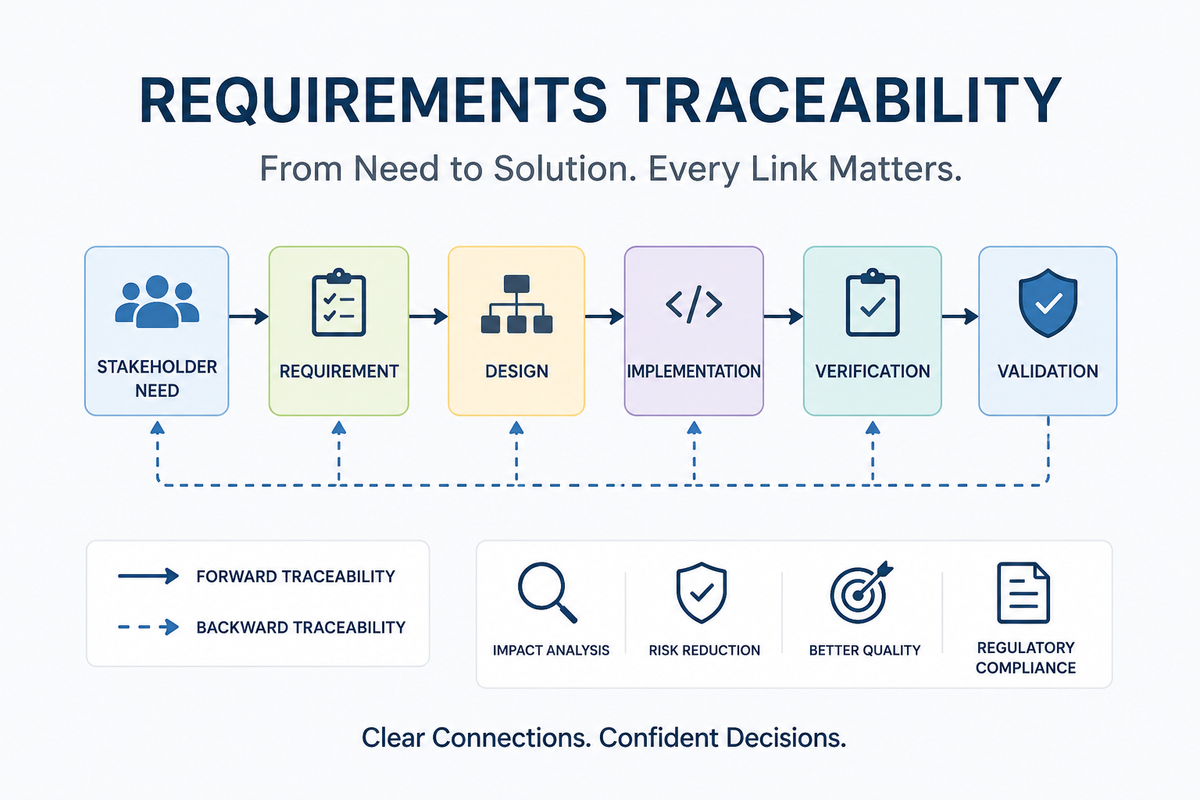
Requirements traceability is one of those engineering practices everyone agrees is important, but many teams struggle to maintain once the project becomes real.
At the beginning, traceability feels simple. A stakeholder need becomes a system requirement. That requirement becomes a design decision. The design is implemented, verified, and eventually delivered.
But as the system grows, requirements change. Designs evolve. Tests are rewritten. Suppliers provide new constraints. Customer comments arrive late. Suddenly, nobody is fully sure which requirement drove which design choice, which tests prove compliance, or what will break if one line in the specification changes.
That is the problem requirements traceability is meant to solve.
What Is Requirements Traceability?
Requirements traceability is the ability to follow a requirement throughout its life cycle: from its origin, through specification, design, implementation, verification, validation, and change. It answers a simple but powerful question:
Where did this requirement come from, and where did it go?
Good traceability connects requirements to the engineering artifacts around them, such as:
- stakeholder needs
- system requirements
- subsystem requirements
- interface requirements
- architecture elements
- design decisions
- risks
- verification methods
- test cases
- test results
- change requests
- compliance evidence
In practice, traceability gives teams a map of the engineering logic behind the system.
Forward vs Backward Traceability
There are two basic directions of traceability: forward and backward.
Forward traceability follows a requirement downstream. It asks:
What happened because of this requirement?
For example:
A customer need leads to a system requirement.
That system requirement leads to a software requirement.
The software requirement leads to a design element.
The design element leads to a test case.
The test case leads to a test result.
Forward traceability helps confirm that every requirement has been addressed, implemented, and verified.
Backward traceability works in the opposite direction. It asks:
Why does this thing exist?
For example:
A test case should trace back to the requirement it verifies.
A design feature should trace back to the requirement that justified it.
A subsystem requirement should trace back to a parent system requirement or stakeholder need.
Backward traceability helps teams detect unnecessary work, unexplained features, duplicate requirements, and design decisions that no longer have a valid purpose.
Together, forward and backward traceability form bidirectional traceability. NASA defines bidirectional traceability as the ability to trace a requirement to both its parent and its allocated child requirements. This is essential because traceability is not only about coverage. It is also about justification.
Why Traceability Matters
Traceability matters because engineering decisions compound over time.
A vague requirement becomes a design assumption.
A design assumption becomes an implementation choice.
An implementation choice becomes a test limitation.
A test limitation becomes a product risk.
Without traceability, these connections are hidden.
With traceability, teams can answer questions like:
- Are all stakeholder needs covered?
- Are all system requirements decomposed properly?
- Does every lower-level requirement have a valid parent?
- Which requirements are affected by this design change?
- Which tests prove this requirement is satisfied?
- Which requirements are still unverified?
- Are we building anything the customer did not ask for?
- Are we missing anything the customer did ask for?
This is especially important in regulated, safety-critical, complex, or multi-disciplinary engineering environments. But traceability is not only for aerospace, defense, or medical devices. It matters in automotive systems, industrial automation, energy systems, robotics, software platforms, infrastructure projects, consumer electronics, and any product where requirements, design, and verification must stay aligned.
The Traceability Matrix
The most familiar traceability tool is the Requirements Traceability Matrix, or RTM.
An RTM is usually a table that links requirements to related artifacts. A simple version might include:
| Requirement ID | Parent Requirement | Design Element | Verification Method | Test Case | Status |
|---|---|---|---|---|---|
| SYS-REQ-014 | STK-NEED-003 | Controller Logic | Test | TC-014 | Verified |
This works well for small projects. The problem is that spreadsheets become fragile as complexity grows.
Rows get copied. Links become outdated. Test cases change names. Requirements are deleted but traces remain. Engineers start maintaining the matrix only before reviews, instead of using it as a living engineering asset.
That is when traceability becomes theatre instead of truth.
Common Traceability Pitfalls
1. Treating traceability as documentation after the fact
Traceability should not be created only before a design review, audit, or customer delivery. If the trace is built after the engineering work is already done, it often becomes a reconstruction exercise.
The better approach is to create trace links as decisions are made.
2. Linking everything to everything
More trace links do not automatically mean better traceability. Too many weak links create noise. Engineers stop trusting the data because every artifact appears connected to everything else.
Good traceability is intentional. Each link should explain a meaningful relationship.
3. Confusing decomposition with duplication
A lower-level requirement should refine, allocate, or derive from a higher-level requirement. It should not simply repeat the same sentence at another level.
Duplicated requirements create false confidence. They make the trace look complete while adding little technical value.
4. Missing rationale
A trace link tells you that two artifacts are related. Rationale explains why.
Without rationale, future engineers may know that a design traces to a requirement, but not why that design was chosen, what alternatives were rejected, or what assumptions were made.
5. Not tracing verification evidence
A requirement is not truly managed unless the team knows how it will be verified.
Every requirement should eventually connect to a verification method, test case, analysis, inspection, demonstration, or other evidence. Otherwise, teams may discover too late that a requirement is not actually testable.
6. Letting traceability decay during change
Traceability usually fails during change, not during initial setup.
A requirement changes. A design is updated. A test case is modified. But the trace links are not updated. Over time, the traceability structure becomes stale and unreliable.
This is why change impact analysis is one of the most valuable uses of traceability.
Maintaining Traceability at Scale
Traceability at scale requires more than a matrix. It requires a system.
Here are practical principles that help.
1. Define what must be traced
Not every artifact needs the same level of traceability. Teams should define a traceability strategy early.
For example:
- stakeholder needs trace to system requirements
- system requirements trace to subsystem requirements
- requirements trace to architecture elements
- requirements trace to verification methods
- verification methods trace to test cases and results
- risks trace to mitigations and requirements
- change requests trace to affected requirements and artifacts
The goal is not maximum traceability. The goal is useful traceability.
2. Use stable identifiers
Every requirement needs a unique and stable ID. The ID should not change just because the requirement moves to another section of a document.
Stable identifiers make traceability possible across tools, documents, reviews, baselines, and releases.
3. Separate requirement text from metadata
A requirement is not just a sentence. It also needs attributes such as:
- ID
- owner
- source
- rationale
- priority
- verification method
- status
- risk level
- allocation
- version
- change history
This metadata helps teams manage the requirement over time.
4. Use baselines
A baseline freezes a known version of the requirements set. This is important because traceability is only meaningful if the team knows which version of the requirement was linked, reviewed, implemented, or verified.
Without baselines, teams may argue over moving targets.
5. Make traceability part of reviews
Design reviews should not only ask, “Does this design work?”
They should also ask:
- Which requirements does this design satisfy?
- Which requirements are not yet allocated?
- Which design features have no requirement basis?
- Which requirements have no verification path?
- What changed since the last baseline?
- What is the impact of this change?
Traceability should improve review quality, not simply satisfy a checklist.
6. Automate the boring parts
Manual traceability does not scale well.
As projects grow, engineers spend more time maintaining links, updating matrices, checking consistency, and hunting for broken relationships. This is where automated requirement analysis becomes valuable.
Automation can help identify:
- missing parent-child links
- orphan requirements
- unverified requirements
- duplicate or near-duplicate requirements
- vague or unverifiable requirement statements
- requirements affected by a change
- inconsistent terminology
- possible trace links between related artifacts
- gaps between stakeholder needs and verification evidence
Recent research continues to explore machine learning and large language models for traceability link recovery and requirements engineering support. The direction is clear: AI will not replace engineering judgment, but it can reduce the manual burden of finding, checking, and maintaining trace relationships.
This is exactly the type of gap Ngenaire is being built to address.
Ngenaire can help engineering teams move beyond static requirement documents and fragile spreadsheets by using AI-assisted requirement analysis to surface quality issues, suggest traceability relationships, detect gaps, and support change impact analysis. The engineer remains responsible for judgment and approval, but the platform helps expose issues earlier, before they become expensive review findings or late-stage rework.
In other words, Ngenaire is not about replacing systems engineers. It is about giving them better visibility across the engineering lifecycle.
What Good Traceability Looks Like
Good traceability should feel useful, not bureaucratic.
A healthy traceability system has these qualities:
- every requirement has a clear source
- every lower-level requirement has a justified parent
- every requirement has a verification path
- every test maps back to something required
- every design feature has a reason to exist
- changes show their downstream and upstream impact
- trace links are maintained continuously
- engineers trust the data enough to use it during real decisions
Traceability is not just about proving compliance at the end. It is about making better decisions throughout the project.
Final Thought
Requirements traceability is often misunderstood as paperwork.
It is not.
Traceability is engineering memory.
It preserves why decisions were made, how requirements flow through the system, and what evidence proves the system does what it was supposed to do.
When traceability is weak, teams lose context. They rediscover old decisions, miss change impacts, overbuild unnecessary features, and struggle to prove compliance.
When traceability is strong, teams move with more confidence. They can change faster, review better, verify smarter, and explain their engineering decisions clearly.
The goal is not to create a perfect matrix.
The goal is to create a living chain of reasoning from need to requirement, requirement to design, design to verification, and verification to delivered value.
That is what traceability is really for.
Sources
- ISO/IEC/IEEE 29148:2018, Systems and software engineering — Life cycle processes — Requirements engineering.
- NASA, NASA Systems Engineering Handbook, Rev. 2.
- NASA, Systems Engineering Handbook Appendix, definition of bidirectional traceability.
- Gotel, O. C. Z., & Finkelstein, A. C. W. “An Analysis of the Requirements Traceability Problem,” 1994.
- Kasauli, R., et al. “Requirements engineering challenges and practices in large-scale agile system development,” Journal of Systems and Software, 2021.
- Mucha, J., et al. “A systematic literature review of pre-requirements specification traceability,” Requirements Engineering, 2024.
- Alturayeif, N., et al. “Machine learning approaches for automated software traceability: A systematic literature review,” Journal of Systems and Software, 2025.
- Legesse, H. “AI-Enhanced Requirements Traceability Using MBSE and LLM for Complex Systems,” SERC Research Review, 2025.
- Federal Highway Administration, Systems Engineering for Intelligent Transportation Systems: Traceability.
- INCOSE Requirements Working Group, traceability webinar material.