
The Most Common Systems Engineering Mistakes and How to Avoid Them
Most systems engineering failures don't happen because of one catastrophic mistake—they result from small process gaps that compound over time. Learn the six most common systems engineering mistakes and practical strategies to prevent costly rework, delays, and integration failures.
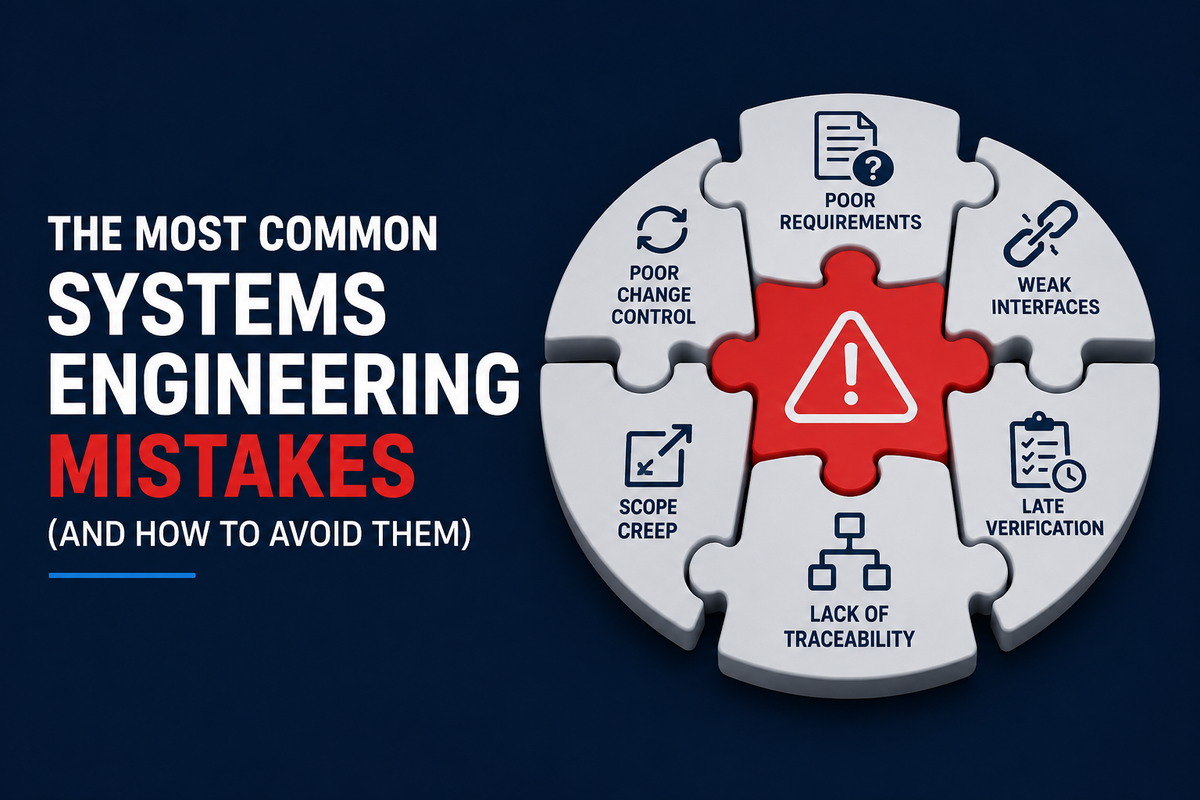
Systems engineering rarely fails because one person missed one task. It fails because small gaps compound: vague requirements become misunderstood designs, weak interfaces become integration problems, late verification becomes expensive rework, and uncontrolled changes slowly reshape the system without anyone noticing.
The discipline exists to prevent exactly this. Standards such as ISO/IEC/IEEE 29148 emphasize requirements that are well-formed, traceable, verifiable, and managed across the life cycle [1]. NASA’s Systems Engineering Handbook similarly treats requirements, interfaces, verification, validation, risk, and configuration management as connected technical processes rather than isolated paperwork [2].
Below are some of the most common systems engineering mistakes and how teams can avoid them.
1. Poor Requirements
Bad requirements are one of the earliest and most expensive mistakes. A requirement that is vague, unverifiable, compound, or solution-biased can look harmless during planning but cause major confusion during design, procurement, implementation, and testing.
Examples include:
“The system shall be user friendly.”
“The sensor shall provide fast response.”
“The platform shall support future upgrades.”
These statements may sound reasonable, but they do not give engineers enough precision. What does “fast” mean? Who defines “user friendly”? Which upgrades are expected?
A better requirement defines a clear capability, condition, constraint, or performance threshold that can be verified. ISO/IEC/IEEE 29148 provides guidance for well-formed requirements and requirement characteristics, including clarity, completeness, consistency, feasibility, and verifiability [1].
How to avoid it:
Start with stakeholder needs before writing system requirements. Separate needs, requirements, design choices, and verification methods. Use structured requirement patterns such as EARS when appropriate. Review requirements for ambiguity, unverifiable language, missing units, hidden assumptions, and compound statements before they enter a baseline.
This is where automated requirement analysis becomes valuable. Research on natural language processing for requirements engineering shows that NLP can help detect ambiguity, incompleteness, inconsistency, and quality issues in natural-language requirements [3], [4]. Ngenaire fits into this gap by helping engineering teams analyze requirements earlier, flag weak wording, identify missing verification logic, and reduce the manual burden of reviewing large requirement sets. It does not replace engineering judgment; it gives engineers faster feedback before poor requirements become expensive downstream problems.
2. Weak Interface Definition
Interfaces are where systems meet reality. Mechanical, electrical, software, data, human, operational, and organizational interfaces often become failure points because each team assumes the other side understands the same thing.
An interface problem may appear as a connector mismatch, an undefined data field, a timing issue, a thermal constraint, a mounting incompatibility, or a responsibility gap between suppliers. Interface management is widely recognized as a core systems engineering activity, and NASA explicitly connects interface definition and control with system integration success [2].
How to avoid it:
Define interfaces early and maintain them as controlled engineering artifacts. Use interface control documents, interface matrices, model-based interface definitions, and regular cross-discipline reviews. Do not treat interfaces as side notes in design documents. Every important interface should have an owner, a source, a destination, agreed parameters, assumptions, constraints, and verification evidence.
3. Late Verification Planning
A common mistake is treating verification as something that happens after the design is complete. By then, the team may discover that some requirements cannot be tested, some acceptance criteria were never defined, and some design decisions made verification unnecessarily difficult.
Verification should begin when requirements are written. ISO/IEC/IEEE 29148 describes requirements engineering as including the determination of verification methods, not just writing requirement statements [1]. NASA also presents verification and validation as life-cycle activities, not final-stage paperwork [2].
How to avoid it:
For every requirement, define how it will be verified: test, analysis, inspection, demonstration, or a combination. Ask early: What evidence will prove this requirement is satisfied? What equipment, environment, data, or model will be needed? Is the requirement actually testable?
A requirement without a verification path is not ready.
4. Lack of Traceability
Traceability connects the “why,” “what,” “how,” and “proof” of a system. Without it, teams struggle to answer basic questions:
Which stakeholder need does this requirement satisfy?
Which design element implements it?
Which test verifies it?
What happens if this requirement changes?
Traceability enables impact analysis, compliance evidence, design justification, and verification coverage. INCOSE guidance describes traceability as the ability to identify and manage relationships between engineering artifacts [5].
How to avoid it:
Build traceability as work happens, not as a cleanup activity before a review. Link needs to requirements, requirements to architecture, architecture to implementation, and implementation to verification. Keep trace links current when changes occur. Avoid spreadsheet-only traceability when the system becomes too large or dynamic to manage manually.
Ngenaire can help here by supporting the engineering flow from requirements into architecture, verification, documentation, and change impact. The goal is to make traceability a living part of the engineering process rather than a painful end-of-project reconstruction exercise.
5. Scope Creep
Scope creep happens when new features, constraints, interpretations, or stakeholder requests enter the system without proper evaluation. It often starts innocently: “Can we just add this?” or “This should be easy.” But every change has consequences.
Unchecked scope growth affects cost, schedule, architecture, interfaces, verification, documentation, and risk. NASA’s handbook treats technical planning, requirements management, risk management, and configuration management as connected because changes in one area affect the others [2].
How to avoid it:
Define the baseline clearly. Separate must-have requirements from future enhancements. Evaluate every proposed change for cost, schedule, technical risk, interface impact, verification impact, and contractual impact. Make trade-offs visible before accepting the change.
Good systems engineering does not prevent change. It prevents unmanaged change.
6. Poor Change Control
Change control is often misunderstood as bureaucracy. In reality, it is how teams protect the integrity of the system while still allowing it to evolve.
Poor change control leads to teams working from different assumptions, outdated documents, inconsistent baselines, and surprise integration failures. Requirements management includes controlling changes to requirements once they are agreed upon [6].
How to avoid it:
Use a clear change request process. Document the reason for the change, affected requirements, affected interfaces, affected verification activities, affected documents, and approval status. Maintain baselines. Communicate approved changes to every impacted team.
The key question is not “Can we change it?” The key question is “Do we understand the consequences of changing it?”
7. Treating Documentation as the Product
Systems engineering produces documents, but documents are not the system. A team can have many documents and still lack shared understanding. The real value comes from the relationships between needs, requirements, architecture, interfaces, risks, decisions, implementation, and verification evidence.
Documentation becomes dangerous when it is duplicated, stale, disconnected, or written only for compliance. In that environment, engineers spend too much time maintaining artifacts and not enough time solving engineering problems.
How to avoid it:
Create documentation from structured engineering data wherever possible. Keep a single source of truth. Automate repetitive documentation tasks. Use reviews to evaluate engineering decisions, not just document formatting.
This is central to Ngenaire’s purpose: reducing documentation overhead while preserving engineering rigor. Engineers should spend more time designing, testing, analyzing, and making decisions, while the platform helps maintain the structure, traceability, and requirement quality in the background.
Final Thought
Most systems engineering mistakes are not mysterious. They come from weak foundations: unclear requirements, unmanaged interfaces, delayed verification, missing traceability, uncontrolled scope, and poor change discipline.
The solution is not more paperwork. The solution is better engineering structure.
When requirements are clear, interfaces are controlled, verification is planned early, traceability is maintained, and changes are evaluated systematically, teams move faster with less rework. Automation can make this easier, especially for requirement analysis and documentation-heavy workflows, but the goal is still the same: help engineers build the right system, prove it works, and understand the impact of every decision.
References
[1] ISO/IEC/IEEE, “ISO/IEC/IEEE 29148:2018, Systems and software engineering — Life cycle processes — Requirements engineering,” 2018.
[2] NASA, “NASA Systems Engineering Handbook,” NASA/SP-2016-6105 Rev2, 2016.
[3] L. Zhao et al., “Natural Language Processing for Requirements Engineering: A Systematic Mapping Study,” ACM Computing Surveys, 2021.
[4] A. Bajceta, L. M. Cysneiros, and G. Mussbacher, “Using NLP Tools to Detect Ambiguities in System Requirements — A Comparison Study,” 2021.
[5] INCOSE Requirements Working Group, “Traceability,” INCOSE Webinar Series, 2026.
[6] INCOSE, “Systems Engineering Guidebook,” 2018.