
How AI Is Changing the Future of Systems Engineering
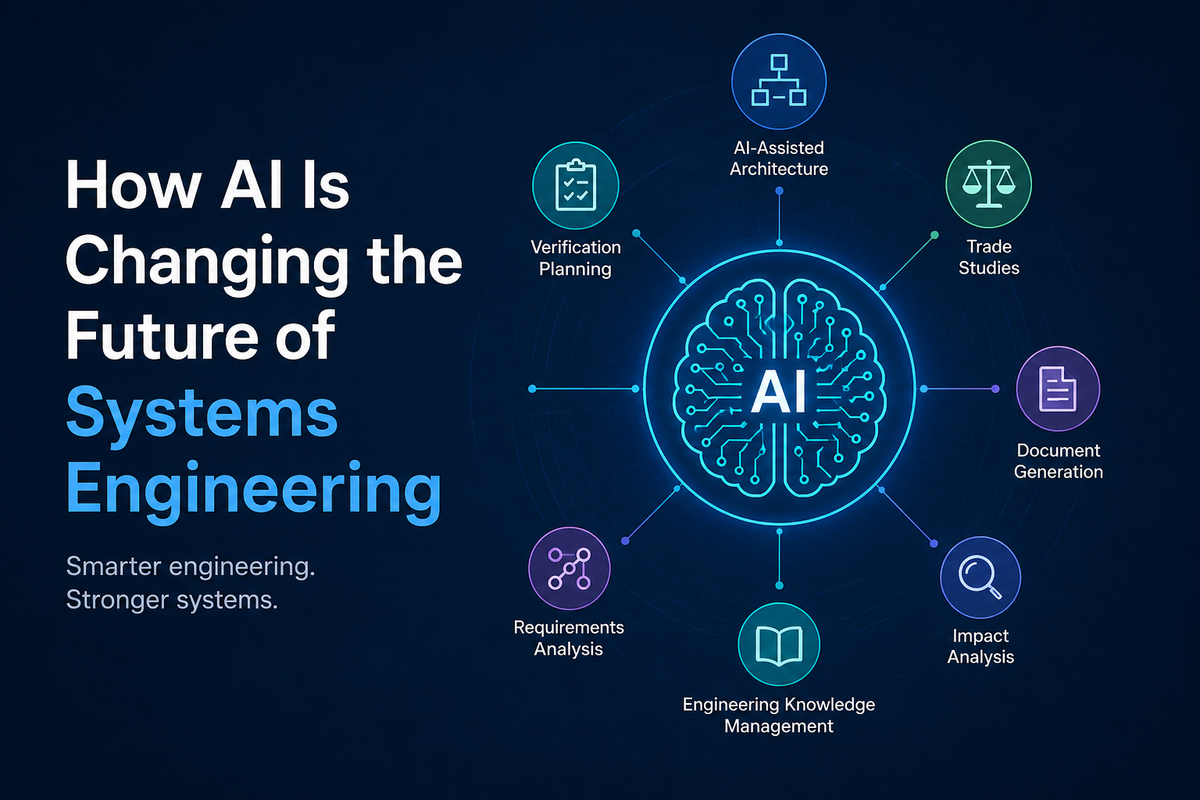
AI is moving beyond requirement writing. Explore how it is transforming architecture, verification, trade studies, impact analysis, documentation, and engineering knowledge management.
Systems engineering has always been about managing complexity.
Requirements, architecture, interfaces, verification, trade studies, change control, and documentation all need to stay connected as a system evolves. The challenge is that modern engineering programs now move faster than traditional systems engineering workflows can comfortably support.
AI is beginning to change that.
Not by replacing systems engineers, but by helping them reason across large amounts of technical information faster, earlier, and with better continuity.
AI Is Not Just About Writing Requirements
A lot of discussion around AI in systems engineering starts with requirements writing. That makes sense. Requirements are often written in natural language, and natural language is where large language models and natural language processing tools are immediately useful.
But the future of AI in systems engineering is much broader.
AI can support:
- Architecture exploration
- Verification planning
- Trade studies
- Interface analysis
- Document generation
- Change impact analysis
- Requirements quality review
- Engineering knowledge management
- Traceability across the lifecycle
This matters because systems engineering is not one document or one phase. It is the connective tissue between stakeholder needs, design decisions, implementation, testing, and operations.
1. AI-Assisted Architecture
Architecture is where systems engineering starts to become real.
A good architecture translates needs and requirements into functions, interfaces, components, behaviours, constraints, and design alternatives. Traditionally, much of this depends on workshops, expert judgment, diagrams, spreadsheets, and review cycles.
AI can help engineers explore architecture options faster by identifying missing functions, suggesting logical decompositions, comparing alternatives, and surfacing interface risks.
For example, an AI assistant could review a set of system requirements and suggest:
- Candidate system functions
- Possible subsystem boundaries
- Interface dependencies
- Areas where requirements are over-constraining the design
- Conflicts between performance, cost, reliability, and maintainability
This does not remove the architect’s role. It makes the architect more effective.
The systems engineer still decides what architecture is technically valid. AI simply helps generate options, expose blind spots, and reduce the time spent manually searching through scattered information.
2. AI in Verification Planning
Verification planning is often treated as something that happens after requirements are written. That is a mistake.
Every requirement should eventually connect to a verification method, test case, analysis, inspection, or demonstration. If a requirement cannot be verified, the problem should be discovered early, not during integration or acceptance testing.
AI can help by reviewing requirements and suggesting likely verification approaches. It can flag requirements that are not testable, identify missing acceptance criteria, and detect cases where verification evidence may be difficult or expensive to obtain.
For example:
A requirement that says “the system shall provide fast response time” is not verification-ready.
AI can flag that “fast” is ambiguous and suggest that the requirement needs a measurable threshold, operational condition, and verification method.
This is where automated requirement analysis becomes valuable. Ngenaire can help fill this gap by reviewing requirements for ambiguity, incompleteness, weak wording, missing verification logic, and traceability gaps before those issues become expensive downstream problems.
3. AI-Assisted Trade Studies
Trade studies are central to engineering decision-making.
Teams compare alternatives based on cost, performance, risk, schedule, complexity, reliability, safety, manufacturability, and maintainability. The problem is not that engineers lack judgment. The problem is that trade study information is often fragmented across meetings, documents, spreadsheets, simulation results, supplier data, and old project lessons.
AI can help organize that information.
It can summarize options, extract decision criteria, compare alternatives, identify missing assumptions, and generate first-pass trade matrices. It can also help engineers reuse prior decisions by finding similar past trade studies and explaining what was decided and why.
This is especially powerful when combined with digital engineering and model-based systems engineering. If requirements, architecture, analyses, verification plans, and design decisions are connected, AI can reason across the engineering baseline instead of operating on isolated documents.
4. AI for Document Generation
Engineering documentation is necessary, but it is also one of the biggest sources of friction.
System specifications, interface control documents, verification plans, compliance matrices, design review packages, CONOPS documents, test procedures, and change impact reports all take time to produce and maintain.
AI can help generate first drafts from structured engineering data.
For example, if the platform already understands the requirements, architecture, interfaces, risks, and verification strategy, it can produce a draft verification plan or design review package with far less manual effort.
The key is that AI-generated documents should not be treated as final authority. They should be reviewable engineering artifacts generated from controlled information.
This distinction matters.
Bad AI documentation creates more noise. Good AI documentation reduces repetitive work while keeping engineers in control.
5. AI for Change Impact Analysis
Change is where many engineering processes break down.
A customer changes a requirement. A supplier changes a component. A test result fails. A regulation updates. A design decision is reversed.
The question becomes: what else is affected?
Manual impact analysis is slow because the answer may be spread across requirements, interfaces, architecture diagrams, verification plans, test procedures, compliance matrices, and design documents.
AI can help by tracing likely impact paths.
It can identify related requirements, affected interfaces, dependent subsystems, impacted verification activities, and documentation that may need revision. This does not eliminate formal change control, but it makes change review faster and more complete.
Instead of asking engineers to manually search every artifact, AI can provide a structured starting point:
“This change may affect these requirements, these interfaces, these verification cases, and these documents.”
The engineer then reviews, confirms, rejects, or expands the analysis.
6. AI for Engineering Knowledge Management
One of the most underrated problems in systems engineering is knowledge loss.
Engineering decisions are made every day, but the reasoning behind those decisions is often buried in emails, meeting notes, chat threads, old presentations, or someone’s memory.
When people leave, projects restart, or teams scale, that knowledge disappears.
AI can help turn engineering history into usable knowledge.
Imagine being able to ask:
- Why was this interface defined this way?
- What trade studies led to this architecture?
- Which requirements changed after the last design review?
- What verification evidence supports this compliance claim?
- Have we solved a similar problem before?
This is where AI becomes more than a writing assistant. It becomes a knowledge layer across the engineering organization.
The long-term value is not just faster documentation. It is better technical memory.
7. AI and the Digital Thread
AI becomes much more useful when it operates on a connected engineering baseline.
This is why the digital thread matters.
A digital thread connects stakeholder needs, requirements, architecture, design, implementation, verification, validation, operations, and change history. Without that connection, AI can only summarize isolated documents. With that connection, AI can reason across the lifecycle.
For example, a requirement change can automatically trigger questions such as:
- Which architecture elements are affected?
- Which interfaces depend on this requirement?
- Which verification cases need to be updated?
- Which documents reference outdated information?
- Which stakeholders need to review the change?
That is the real future of AI in systems engineering: not isolated chatbots, but AI working inside connected engineering workflows.
8. The Role of the Systems Engineer Will Change
AI will not remove the need for systems engineers.
It will change what systems engineers spend time doing.
Less time will be spent on repetitive formatting, manual traceability checks, document synchronization, and searching for information. More time will be spent on judgment, architecture, risk, stakeholder alignment, verification strategy, and technical decision-making.
The systems engineer becomes less of a document maintainer and more of a technical orchestrator.
That is a good thing.
Systems engineering should not be reduced to paperwork. It should help teams make better decisions about complex systems.
9. The Risks Are Real
AI also introduces risks.
AI can hallucinate. It can generate convincing but wrong statements. It can miss domain-specific constraints. It can create traceability links that look plausible but are technically invalid. It can produce documentation that sounds complete while hiding gaps.
That means AI must be used with engineering discipline.
Good AI-assisted systems engineering needs:
- Human review
- Traceable outputs
- Controlled source data
- Clear approval workflows
- Version control
- Explainable recommendations
- Configuration management
- Verification of AI-generated artifacts
The goal is not autonomous engineering. The goal is augmented engineering.
AI should help engineers move faster without weakening technical rigor.
10. Where Ngenaire Fits
Ngenaire is being built around this exact problem: helping engineers move faster while reducing documentation overhead and preserving technical quality.
For automated requirement analysis, Ngenaire can help identify ambiguity, weak wording, missing verification logic, traceability gaps, and inconsistent requirement structure. But the broader opportunity goes beyond requirements.
The larger vision is an engineering platform where requirements, architecture, verification, documentation, and change impact analysis are connected. AI then becomes useful because it is not operating on disconnected files. It is working within the engineering context.
That is how AI can help engineers spend less time chasing documents and more time designing, testing, iterating, and solving hard problems.
Final Thoughts
AI is not the future of systems engineering by itself.
The future is AI combined with sound engineering process, connected data, model-based thinking, and human judgment.
The organizations that benefit most will not be the ones that simply add a chatbot to their workflow. They will be the ones that use AI to strengthen the digital thread between requirements, architecture, verification, change control, and engineering knowledge.
Systems engineering is becoming more connected, more model-based, and more intelligent.
AI will not replace the systems engineer.
But systems engineers who learn how to use AI effectively will have a major advantage.
References
[1] INCOSE, Systems Engineering Vision 2035: Engineering Solutions for a Better World, International Council on Systems Engineering, 2022.
[2] NASA, NASA Systems Engineering Handbook, NASA/SP-2016-6105 Rev. 2, 2016.
[3] ISO/IEC/IEEE, ISO/IEC/IEEE 29148:2018 Systems and Software Engineering — Life Cycle Processes — Requirements Engineering, 2018.
[4] NIST, Artificial Intelligence Risk Management Framework (AI RMF 1.0), NIST AI 100-1, National Institute of Standards and Technology, 2023.
[5] NIST, Artificial Intelligence Risk Management Framework: Generative Artificial Intelligence Profile, NIST AI 600-1, National Institute of Standards and Technology, 2024.
[6] Office of the Deputy Assistant Secretary of Defense for Systems Engineering, Digital Engineering Strategy, U.S. Department of Defense, 2018.
[7] SEBoK Editorial Board, “Digital Engineering,” The Guide to the Systems Engineering Body of Knowledge (SEBoK), 2025.
[8] A. Bajceta, D. Binkley, R. Capilla, and S. C. B. de Souza, “Using NLP Tools to Detect Ambiguities in System Requirements — A Comparison Study,” NLP4RE Workshop Proceedings, 2021.
[9] C. K. Sahu, V. Rai, and V. Roshan, “Well-Formed Quality of System Requirements for Verifying to ISO 29148-2018: A Natural Language Processing Based Framework and Quantitative Metric,” ASME International Design Engineering Technical Conferences and Computers and Information in Engineering Conference, 2024.
[10] H. Legesse, AI-Enhanced Requirements Traceability Using MBSE and Large Language Models for Complex Systems, Systems Engineering Research Center, 2025.
[11] T. Xu, et al., “AI-Integrated Framework for Enhancing High Level Architecture Design Across the System Lifecycle,” MODELSWARD, 2025.
[12] S. Martínez-Fernández, et al., “Software Engineering for AI-Based Systems: A Survey,” ACM Transactions on Software Engineering and Methodology, 2022.
[13] S. Otten, P. Reis, P. Rigoll, J. Ransiek, T. Schürmann, J. Langner, and E. Sax, “Generative AI in Systems Engineering: A Framework for Risk Assessment of Large Language Models,” arXiv, 2026.
[14] J. Cederbladh, A. Cicchetti, and J. Suryadevara, “Early Validation and Verification of System Behaviour in Model-Based Systems Engineering: A Systematic Literature Review,” ACM Transactions on Software Engineering and Methodology, 2024.
[15] C. Ge, et al., “Cross-Level Requirements Tracing Based on Large Language Models,” IEEE Transactions on Software Engineering, 2025.