
Why Engineering Documentation Becomes a Bottleneck
Engineering documentation becomes a bottleneck when requirements, decisions, tests, and changes are duplicated across disconnected tools. Learn how documentation debt develops—and how connected, human-guided automation can reduce repetitive work.
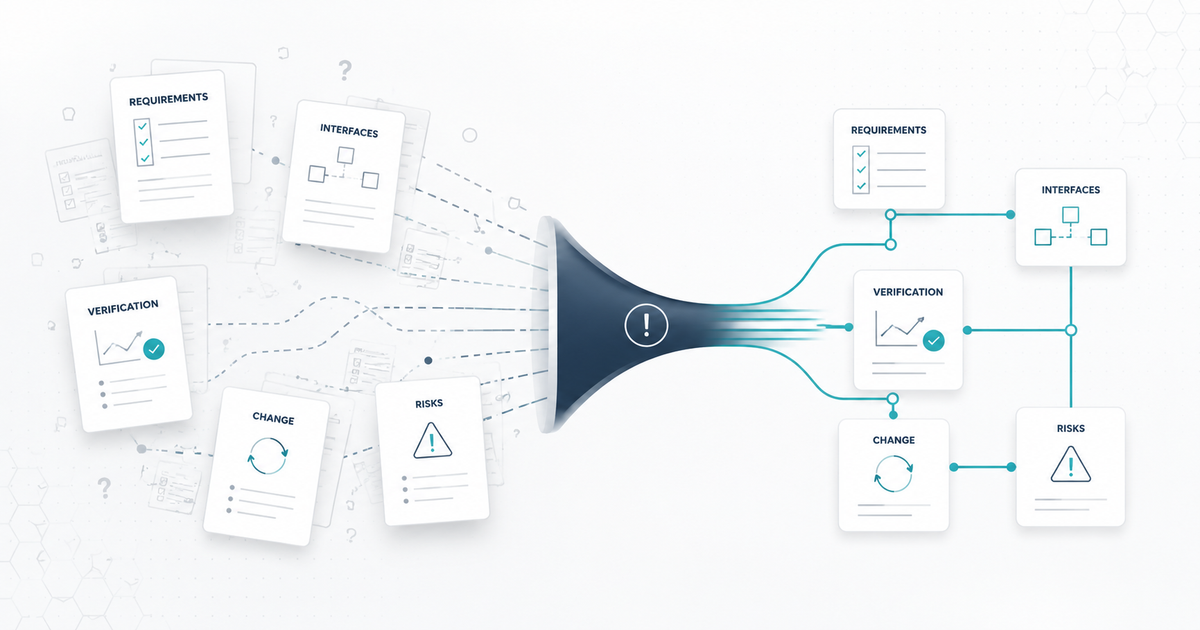
Engineering documentation is intended to make complex work manageable.
Requirements establish what must be achieved. Architecture descriptions explain how a system is organized. Interface control documents coordinate subsystem boundaries. Risk registers capture uncertainty. Verification plans define how compliance will be demonstrated. Change records preserve the evolution of the design.
Yet documentation frequently becomes one of the largest sources of friction in an engineering program.
Engineers spend hours searching for information, comparing conflicting documents, copying data between tools, preparing review packages, updating traceability matrices, and determining whether a change has been reflected everywhere it should be.
The problem is not simply that engineering teams produce too many documents. The deeper problem is that important engineering information becomes fragmented across documents, spreadsheets, models, emails, tickets, databases, and personal knowledge.
Once that happens, documentation stops supporting engineering work and begins competing with it.
Documentation Is Not the Bottleneck—Disconnected Information Is
A complex system naturally requires substantial documentation. Reducing the number of documents does not necessarily solve the problem.
A short but inaccurate interface specification is more dangerous than a detailed, well-controlled one. A simplified verification matrix is not useful if it omits critical requirements. A single large document is not an authoritative source merely because all the information has been copied into it.
Documentation becomes a bottleneck when engineers cannot confidently answer basic questions such as:
- What is the latest approved requirement?
- Why was this requirement introduced?
- Which subsystem is responsible for satisfying it?
- Which interface depends on it?
- Has it been verified?
- Which test procedure demonstrates compliance?
- What changed since the previous baseline?
- Which other artifacts are affected by the change?
NASA’s requirements-management guidance describes requirements management as more than storing requirement statements. It includes controlling changes, maintaining bidirectional traceability, keeping requirements consistent with the operational concept and architecture, and connecting requirements to design documents, test plans, and procedures [3].
When those connections must be reconstructed manually, documentation has already become part of the critical path.
The Accumulation of Documentation Debt
Documentation debt is the future effort created when engineering information is missing, incomplete, outdated, inconsistent, or difficult to retrieve.
It resembles technical debt. A team accepts a documentation shortcut to meet an immediate schedule objective, but the cost reappears later through additional investigation, rework, review time, onboarding effort, or verification risk.
Recent research characterizes documentation debt as particularly difficult because inaccurate or outdated information may continue to appear authoritative. Paying it down can also require more than simply assigning someone to update old documents. Organizations must determine what is still valid, identify knowledgeable contributors, reconstruct undocumented decisions, and evaluate whether the resulting documentation can be trusted [1].
Documentation debt commonly develops through small, understandable decisions:
- A design change is approved, but the related test procedure will be updated later.
- A requirement is copied into a spreadsheet because a supplier cannot access the requirements tool.
- An interface assumption is discussed in a meeting but never entered into the interface document.
- A diagram is exported into a presentation and then modified independently.
- A test report refers to requirement wording from an older baseline.
- A temporary document becomes the working source because the official repository is difficult to use.
- An engineer leaves before the rationale behind several design decisions is recorded.
No single event may appear serious. The problem is cumulative.
Research into requirements-engineering debt similarly suggests that compromised requirements work can propagate into other artifacts and lifecycle activities. Measuring and tracking that debt, however, remains immature in many organizations [2].
Documentation debt therefore behaves less like an isolated clerical problem and more like an interconnected engineering liability.
Duplicated Work Creates Multiple Versions of the Truth
Duplication is one of the main mechanisms through which documentation debt spreads.
Consider a single system requirement. It may appear in:
- A requirements-management database
- A customer specification
- A compliance matrix
- A subsystem specification
- An architecture model
- A verification cross-reference matrix
- A test plan
- A test procedure
- A design-review presentation
- A supplier statement of work
- A certification or regulatory submission
These artifacts may serve legitimate purposes. The problem arises when each contains an independently maintained copy of the same information.
Once copied, the requirement is no longer simply being displayed in another format. It has become another item that must be governed.
If the source requirement changes, every copy must be found, reviewed, updated, approved, and redistributed. If even one copy is missed, the organization now has conflicting technical instructions.
Research into integrated digital requirements engineering has identified this problem directly. Traditional requirements tools may not integrate deeply with system architecture models, encouraging ad hoc duplication of model elements. The resulting loss of connectivity can produce imprecision, inconsistent terminology, and communication problems [10].
The cost of duplication is therefore not limited to the time required to copy and paste information. Duplication creates an ongoing synchronization obligation.
Engineers End Up Recreating the Same Artifacts
Duplicated information also produces duplicated effort.
A systems engineer may create a requirement-to-verification matrix. A verification engineer then creates another spreadsheet organized around tests. A project manager creates a third summary for a design review. A supplier produces its own compliance matrix. A quality representative manually checks the documents against an approved baseline.
Each person may be doing reasonable work, but the organization is repeatedly transforming the same engineering relationships into different formats.
The result is a documentation production line:
- Export information from one tool.
- Reformat it in another.
- Manually fill missing fields.
- Correct formatting errors.
- Send it for review.
- Receive comments through email.
- Reconcile the comments with the source.
- Repeat the process for the next review.
The deliverable may look polished, but much of the effort produced no new engineering knowledge.
This is an important distinction. Engineering documentation should capture decisions, evidence, interfaces, constraints, and rationale. It should not require engineers to repeatedly recreate information that already exists elsewhere.
Inconsistent Information Is More Dangerous Than Missing Information
Missing information is usually visible.
A blank verification method or unresolved interface is likely to attract attention. Inconsistent information is harder to detect because each individual artifact may appear complete.
For example:
- The system specification requires a response within two seconds, while the subsystem specification permits three seconds.
- An interface document defines a signal as active-high, while the electrical drawing shows it as active-low.
- The requirement refers to one operating temperature range, while the qualification procedure tests another.
- The risk register says a mitigation is complete, but the design feature providing the mitigation was removed.
- The verification matrix marks a requirement as passed, while the test report contains an unresolved anomaly.
- A supplier works from one revision while the internal engineering team uses another.
The System Engineering Body of Knowledge describes requirements management as a lifecycle-wide activity that includes baselining, change management, communication, bidirectional traceability, and alignment with design, interface, verification, and validation artifacts [4]. It also emphasizes the value of tool interoperability in establishing an authoritative source of truth.
Without those connections, every document review becomes partly an exercise in information reconciliation.
The team is no longer asking only, “Is the design correct?”
It must first ask, “Which description of the design should we trust?”
Search Becomes a Hidden Engineering Activity
Documentation bottlenecks are not always visible in project schedules.
Time spent searching for information is often distributed across hundreds of small interactions:
- Looking for the latest approved specification
- Asking who owns a requirement
- Searching emails for a design decision
- Comparing two versions of an interface document
- Checking whether a test result was formally accepted
- Finding the source of a value in a presentation
- Reconstructing the rationale for a requirement
- Determining whether a supplier received the latest revision
Each search may take only a few minutes. Collectively, they can consume a substantial portion of engineering capacity.
The situation becomes worse when information is technically available but cannot be interpreted without context. A requirement may be easy to find but difficult to understand because its rationale, parent need, associated risk, or architectural allocation is stored somewhere else.
This is why document indexing alone is not a complete solution. Finding a document is different from finding the engineering relationship that answers the question.
Change Turns Documentation Friction Into a Bottleneck
Documentation problems become most visible when the system changes.
A change to one requirement may affect:
- Parent and derived requirements
- System architecture
- Subsystem allocations
- Interfaces
- Safety analyses
- Risks and mitigations
- Supplier agreements
- Verification methods
- Test equipment
- Test procedures
- Compliance evidence
- Cost and schedule estimates
- Training or operating instructions
NASA guidance states that requirement changes should be evaluated for their effects on cost, schedule, architecture, design, interfaces, the concept of operations, and higher- and lower-level requirements. It also notes that documentation updates should be included in the change package [3].
This is easy to state as a process requirement and difficult to perform when the relationships are not already captured.
A manual impact analysis depends heavily on engineer memory and document familiarity. The analyst must know which artifacts exist, where they are stored, how they relate to one another, and which teams may have created unofficial copies.
As the system grows, the number of possible relationships grows with it. Change analysis then becomes slower precisely when the program needs fast, confident decisions.
Reviews Become Documentation-Reconciliation Events
Design reviews should evaluate technical maturity, unresolved risk, requirements satisfaction, architecture, interfaces, and readiness for the next lifecycle stage.
Instead, teams often spend the weeks before a review assembling evidence.
Requirements are exported. Traceability matrices are cleaned. Charts are manually updated. Diagrams are reformatted. Open actions are compared against issue trackers. Verification status is copied into presentations. Conflicting values are investigated. Reviewers then identify inconsistencies that originated during preparation rather than in the design itself.
The problem is not that review preparation is unnecessary. A review should require thoughtful synthesis.
The bottleneck appears when the review package must be manually rebuilt because the underlying engineering information is not connected.
A healthy documentation environment should allow the team to generate review views from controlled information. Engineers should spend their preparation time explaining decisions, risks, trades, and evidence—not repairing broken links between files.
Why Adding Another Tool Often Fails
Organizations frequently respond to documentation problems by purchasing another application.
A requirements tool is added for requirements. An issue tracker is added for actions. A document-management system stores files. A modeling tool contains the architecture. A project-management platform tracks schedules and risks. A testing application stores results.
Each tool may improve its own area while making the overall information environment more fragmented.
This happens when tools are deployed as separate repositories rather than components of a connected engineering workflow.
The National Institute of Standards and Technology describes the digital thread as supporting the reuse, repurposing, exchange, and traceability of information across product lifecycle stages, particularly among engineering, manufacturing, and quality functions [5].
The important idea is not that every activity must occur in one enormous application. It is that information should remain connected as it moves between activities.
A tool that creates another isolated source may reduce local effort while increasing lifecycle-wide documentation debt.
Where Automation Can Make the Greatest Difference
Automation is most valuable where engineers are repeatedly performing predictable information-management work.
The objective should not be to remove engineers from important decisions. It should be to reduce the mechanical work required to prepare, inspect, synchronize, and trace engineering information.
Generate Documents From Controlled Information
A report, compliance matrix, review package, test plan, or specification should be generated from controlled engineering data wherever practical.
This approach separates the underlying information from its presentation.
The requirement is maintained once. Different approved views can then be produced for the customer, supplier, verification team, design review, or regulator.
Research into documentation debt has proposed dynamic documentation generation and automated documentation testing as potential approaches. Both depend on establishing a robust underlying information source rather than manually maintaining multiple independent copies [6].
Generated documentation does not eliminate configuration management. It makes configuration management more effective by reducing the number of separately edited representations.
Automate Routine Requirement-Quality Checks
Natural-language requirements remain widely used because they are accessible to many stakeholders. However, natural language can introduce ambiguity, inconsistent terminology, compound statements, incomplete conditions, and unverifiable expectations.
Requirement reviews are therefore cognitively demanding. Experienced engineers must evaluate technical intent while also catching basic writing defects.
Research has observed that requirements-quality assurance remains largely manual and depends on expertise and domain knowledge. That work is often congested by relatively routine language problems that could be detected earlier through automated support [7].
Automated requirement analysis can help identify potential issues such as:
- Ambiguous or subjective terminology
- Multiple obligations contained in one statement
- Missing conditions or performance criteria
- Undefined acronyms and inconsistent terminology
- Weak or unverifiable verbs
- Missing units or tolerances
- Requirements without a clear responsible system element
- Requirements without parent or verification links
- Possible duplication or contradiction
These checks should be treated as engineering assistance, not automatic approval.
A system may identify that “rapidly” is ambiguous. Only the engineer and stakeholders can determine the correct measurable performance. Automation should locate the issue, provide context, and accelerate correction while preserving human authority.
Suggest and Maintain Traceability Links
Traceability is essential, but manually creating and maintaining every relationship becomes increasingly expensive as artifact counts grow.
Natural-language processing has been studied for tasks including detecting language issues, identifying domain concepts, and establishing requirements traceability links. A major systematic mapping study identified 404 relevant studies, although relatively few of the proposed tools had been evaluated in industrial environments or made publicly available [8].
A separate mapping study of NLP for software traceability reviewed 96 papers and identified continuing challenges involving explainability, scalability, data availability, interoperability, and dependence on tacit knowledge [9].
This suggests a practical role for automation:
- Recommend likely parent-child requirement relationships
- Suggest links between requirements and architecture elements
- Identify likely verification artifacts
- Detect orphaned requirements
- Flag links that may have become invalid after a change
- Explain why a relationship was suggested
- Present uncertain links for engineer approval
The most useful system is not one that silently creates thousands of links. It is one that reduces search effort while making its recommendations reviewable.
Support Change-Impact Analysis
When an engineer proposes a change, automation can traverse known relationships and assemble a preliminary impact set.
For example, changing a performance requirement could automatically identify:
- Derived subsystem requirements
- Architecture components allocated to the function
- Interfaces carrying the relevant data
- Risks linked to the performance constraint
- Verification procedures using the old value
- Supplier documents containing the requirement
- Reports generated from the affected baseline
- Open issues associated with the requirement
This does not guarantee that every impact has been found. It gives the change board a defensible starting point and reduces reliance on memory.
The final impact decision remains an engineering responsibility, but the search space becomes manageable.
Detect Inconsistencies Across Artifacts
Automation can compare connected artifacts for possible conflicts.
Examples include:
- Different values or units for the same parameter
- A verification procedure using obsolete requirement wording
- Inconsistent names for the same subsystem
- A requirement marked as verified without linked evidence
- A closed risk with an incomplete mitigation
- A deleted requirement still referenced in a test plan
- A change request approved without all affected artifacts updated
Not every difference is an error. Different documents may intentionally provide different levels of abstraction.
The system should therefore present findings as reviewable inconsistencies rather than independently rewriting controlled engineering information.
How Ngenaire Can Fill the Gap
Ngenaire is designed around the idea that engineering information should be connected, traceable, and reusable rather than repeatedly recreated as isolated documents.
Its role is not simply to generate more text. It is to help teams build and maintain a connected engineering workflow.
Within Ngenaire, requirements can be managed alongside their attributes, rationale, parent relationships, allocations, verification methods, risks, interfaces, and associated change records. Automated requirement-quality analysis can identify potential ambiguity, weak wording, incomplete criteria, duplication, and other quality concerns for engineer review.
The same requirements can then be connected to broader lifecycle artifacts, including:
- Concepts of operations
- System and subsystem architecture
- SysML and UML diagrams
- Interface definitions
- Trade studies
- Risk registers
- Statements of work
- Verification matrices
- Test plans
- Test procedures
- Test reports
- Issues and engineering changes
A network view can show how an engineering artifact relates to the rest of the system. Instead of locating a requirement and then searching several repositories for its context, an engineer can follow its relationships to architecture, risks, verification evidence, and change history.
Ngenaire can also assist with document and report generation. A Requirements Verification Traceability Matrix, test plan, system report, or review summary can be assembled from connected information rather than manually reconstructed from multiple spreadsheets and documents.
Engineering change-management workflows provide the control layer. Proposed changes can be evaluated against linked artifacts, routed through appropriate review and approval steps, incorporated into new baselines, and preserved with their rationale and history.
Access rights and collaborative workflows allow different participants to work with the information appropriate to their responsibilities while maintaining a controlled engineering record.
Most importantly, the automation remains human-guided. Ngenaire can identify potential defects, recommend relationships, summarize change impacts, retrieve supporting information, and prepare draft artifacts. Engineers remain responsible for accepting requirements, approving changes, evaluating risk, and determining whether evidence is technically sufficient.
For organizations with established toolchains, the objective does not have to be immediate replacement. Ngenaire can be tailored to support a specific workflow, connect selected engineering activities, index existing documentation, or automate the portions of the process creating the greatest documentation burden.
The goal is to reduce repetitive engineering administration while preserving engineering judgment.
Moving From Document-Centric to Information-Centric Engineering
Eliminating the documentation bottleneck requires a shift in how engineering information is managed.
A document-centric organization treats each specification, matrix, report, and presentation as an independent deliverable.
An information-centric organization treats requirements, interfaces, risks, decisions, tests, and evidence as controlled engineering objects that can be assembled into different documents and views.
That transition does not need to happen all at once.
A practical starting point is to select one high-friction workflow, such as requirement review, change-impact analysis, compliance-matrix preparation, or verification traceability.
The organization can then:
- Identify the authoritative information involved.
- Define ownership and approval responsibilities.
- Replace unnecessary copies with controlled references or generated views.
- Establish links between requirements and downstream artifacts.
- Automate routine quality and completeness checks.
- Preserve baselines and change rationale.
- Measure where manual reconciliation is still occurring.
Useful indicators of documentation debt may include:
- Requirements without parents
- Requirements without verification methods
- Verification records without evidence
- Duplicate or highly similar requirements
- Documents based on obsolete baselines
- Engineering changes with incomplete impact assessments
- Open issues referenced by supposedly completed artifacts
- Frequently searched information with no clear owner
- Manual reports repeatedly produced from the same source data
These measures turn documentation debt from an invisible frustration into a manageable engineering concern.
Better Documentation Does Not Mean More Documentation
The solution to a documentation bottleneck is not to ask engineers to write more.
It is to ensure that engineering knowledge is captured once, connected to the appropriate context, controlled through change, and reused wherever it is needed.
Good documentation should help a new engineer understand why a decision was made. It should help a reviewer trace a requirement to evidence. It should help a change board identify affected artifacts. It should help a supplier find the current interface definition. It should help a technical lead distinguish an approved baseline from a working proposal.
When documentation cannot perform those functions without extensive manual investigation, the organization does not merely have a writing problem. It has an engineering-information problem.
Automation can reduce that burden, but only when it is applied to controlled, connected information and paired with human review.
The future of engineering documentation is therefore not automatic document generation in isolation. It is the creation of a living, traceable engineering knowledge network from which accurate documents, decisions, and evidence can be produced.
That is how documentation stops being a bottleneck and returns to its proper role: helping engineers build better systems.
References
[1] S. Torkki, E. Penttinen, T. Rinta-Kahila, and J. Ruissalo, “Recommendations for dealing with unexpected challenges in paying back documentation debt,” in Proc. 45th International Conference on Information Systems, 2024.
[2] J. Frattini, D. Fucci, D. Mendez, R. Spinola, V. Mandic, N. Taušan, M. O. Ahmad, and J. Gonzalez-Huerta, “An initial theory to understand and manage requirements engineering debt in practice,” Information and Software Technology, vol. 159, Art. no. 107201, 2023, doi: 10.1016/j.infsof.2023.107201.
[3] S. R. Hirshorn, L. D. Voss, and L. K. Bromley, NASA Systems Engineering Handbook, Rev. 2, NASA/SP-2016-6105, National Aeronautics and Space Administration, Washington, DC, USA, 2017.
[4] BKCASE Editorial Board, “Requirements management,” in Guide to the Systems Engineering Body of Knowledge, accessed Aug. 5, 2026.
[5] National Institute of Standards and Technology, “Enabling the Digital Thread for Smart Manufacturing,” Gaithersburg, MD, USA, updated May 19, 2022, accessed Aug. 5, 2026.
[6] L. Silva, M. Unterkalmsteiner, and K. Wnuk, “Towards identifying and minimizing customer-facing documentation debt,” in Proc. 2023 ACM/IEEE International Conference on Technical Debt, Melbourne, Australia, 2023, pp. 72–81, doi: 10.1109/TechDebt59074.2023.00015.
[7] M. Unterkalmsteiner and T. Gorschek, “Requirements quality assurance in industry: Why, what and how?” in Requirements Engineering: Foundation for Software Quality, Lecture Notes in Computer Science, vol. 10153. Cham, Switzerland: Springer, 2017, pp. 77–84, doi: 10.1007/978-3-319-54045-0_6.
[8] L. Zhao, W. Alhoshan, A. Ferrari, K. J. Letsholo, M. A. Ajagbe, E.-V. Chioasca, and R. T. Batista-Navarro, “Natural language processing for requirements engineering: A systematic mapping study,” ACM Computing Surveys, vol. 54, no. 3, Art. no. 55, pp. 1–41, 2021, doi: 10.1145/3444689.
[9] Z. Pauzi and A. Capiluppi, “Applications of natural language processing in software traceability: A systematic mapping study,” Journal of Systems and Software, vol. 198, Art. no. 111616, 2023, doi: 10.1016/j.jss.2023.111616.
[10] J. S. Wheaton and D. R. Herber, “Digital requirements engineering with an INCOSE-derived SysML meta-model,” in The Proceedings of the 2024 Conference on Systems Engineering Research. Cham, Switzerland: Springer, 2024, pp. 15–26, doi: 10.1007/978-3-031-62554-1_2.