
The Digital Thread Explained: Connecting Engineering from Requirements to Operations
The digital thread connects requirements, architecture, implementation, testing, and operations into one traceable lifecycle. Learn how it differs from a digital twin and why connected engineering information matters.
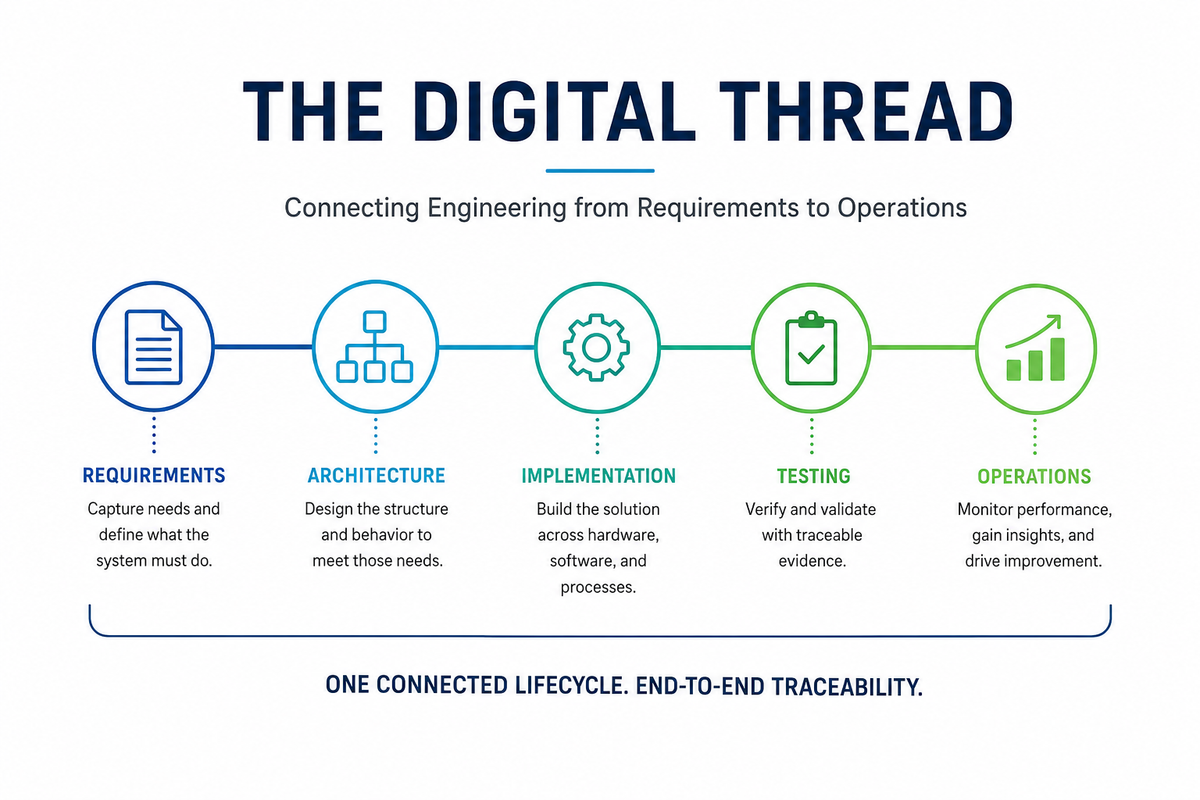
Engineering teams do not usually fail because they lack information. They fail because information is scattered.
Requirements live in one tool. Architecture lives in another. Implementation details live in CAD, code repositories, simulations, spreadsheets, and supplier documents. Test evidence lives somewhere else. Operational data arrives later, often disconnected from the original design intent.
The digital thread is the answer to that fragmentation.
A digital thread is the connected flow of engineering information across the product or system lifecycle. It links requirements, architecture, design, implementation, verification, validation, manufacturing, operations, maintenance, and change history into a traceable information network. NIST describes digital thread work as connecting lifecycle information flows that are often trapped in silos, with the goal of supporting design, manufacturing, and product support processes more effectively.
In simpler terms:
The digital thread shows how engineering decisions are connected.
It answers questions like:
- Which requirement drove this design choice?
- Which subsystem implements this function?
- Which test verifies this requirement?
- Which configuration was tested?
- Which field issue is related to which requirement or design decision?
- What is the impact if this requirement changes?
That last question is where the digital thread becomes especially powerful.
Digital Thread vs Digital Twin
The digital twin and the digital thread are closely related, but they are not the same thing.
A digital twin is a digital representation of a physical product, system, process, or asset. It may be used for simulation, monitoring, prediction, diagnostics, or optimization. NIST’s digital twin work focuses on standards, reference architectures, interoperability, trustworthiness, and verification/validation for digital twins in manufacturing. Deloitte similarly describes a digital twin as a digital representation of a real product or process using feedback between the physical and digital worlds.
A digital thread, on the other hand, is the connected data structure that links lifecycle information together. It is not just a model of the system. It is the traceable relationship between the system’s requirements, architecture, design, implementation, test evidence, configuration, and operational history.
A useful way to think about it:
The digital twin represents the system.
The digital thread explains how the system got there.
The twin may tell you how a product is behaving.
The thread tells you why it was designed that way, what assumptions were made, what evidence supports it, and what may be affected if something changes.
In practice, the digital twin often depends on the digital thread. Deloitte describes the digital twin as being enabled by a digital thread, while NIST refers to digital thread implementation as supporting lifecycle integration and data flow for digital twins.
Why the Digital Thread Matters
Traditional engineering is document-heavy. Teams create specifications, interface documents, architecture diagrams, verification plans, test reports, issue logs, change requests, and operational reports. Each artifact may be useful, but the relationships between them are often weak.
That creates problems.
A requirement may change, but the design team may not know which interface is affected. A test may fail, but the team may not know which requirement or architecture decision is implicated. A field issue may appear during operations, but the original design rationale may be buried in old documents or lost in email.
The digital thread reduces this disconnect by making engineering information traceable.
This aligns with the broader direction of digital engineering. The U.S. Department of Defense defines digital engineering as an integrated digital approach using authoritative sources of system data and models across disciplines to support lifecycle activities from concept through disposal. DoDI 5000.97 also emphasizes current, consistent, enduring, and authoritative sources of truth for digital models and data.
For engineering organizations, this means the goal is not simply “more digital files.” The goal is connected, trustworthy engineering information.
How Requirements Become Connected
The digital thread usually begins with requirements.
Requirements define what the system must do, how well it must perform, what constraints it must satisfy, and what conditions it must operate under. ISO/IEC/IEEE 29148 provides a unified treatment of requirements engineering across the lifecycle of systems and software.
In a digital thread, requirements should not sit as isolated text. They should connect to:
- stakeholder needs
- system functions
- architecture elements
- interface definitions
- design constraints
- verification methods
- test cases
- change requests
- operational issues
For example, a requirement for a medical device alarm should trace to the hazard it mitigates, the function that detects the condition, the software component that triggers the alarm, the interface that displays it, the test case that verifies it, and the operational data that confirms whether alarms are working as intended.
Without this connection, teams are forced to rely on manual reviews, spreadsheets, tribal knowledge, and document searches.
This is where automated requirement analysis becomes important.
Poor requirements break the digital thread before it even begins. If requirements are ambiguous, duplicated, unverifiable, incomplete, or inconsistent, every downstream link becomes weaker. Automated requirement analysis can help detect these issues earlier by checking requirement quality, identifying vague language, flagging missing verification criteria, and helping teams understand the downstream impact of requirement changes.
This is one of the gaps Ngenaire is designed to fill. Ngenaire helps engineering teams analyze requirements, improve clarity, connect requirements to architecture and verification artifacts, and reduce the manual burden of maintaining traceability. Instead of treating requirements as static text, Ngenaire supports the creation of a living requirements foundation that can become part of a broader digital thread.
How Architecture Becomes Connected
Architecture explains how the system is organized.
It connects functions, subsystems, interfaces, behaviors, constraints, and allocation decisions. Model-Based Systems Engineering, or MBSE, is especially important here. INCOSE defines MBSE as the formalized application of modeling to support requirements, design, analysis, verification, and validation from conceptual design through later lifecycle phases.
In a digital thread, architecture becomes the bridge between intent and implementation.
Requirements define what is needed. Architecture explains how the system will satisfy those needs.
A strong architecture thread connects:
- stakeholder needs to system functions
- system functions to logical architecture
- logical architecture to physical architecture
- interfaces to subsystem responsibilities
- design decisions to constraints and trade studies
- architecture elements to verification activities
This makes impact analysis more practical. If a requirement changes, the architecture can show which functions, interfaces, components, and tests may be affected.
How Implementation Becomes Connected
Implementation is where engineering intent becomes real.
Depending on the product, implementation may include software, hardware, mechanical design, electrical design, manufacturing processes, configuration files, supplier parts, control logic, or infrastructure.
In a weak engineering process, implementation artifacts often become disconnected from requirements and architecture. A developer may implement a feature without a clear requirement link. A hardware component may change without updating the architecture. A supplier drawing may not trace back to the original interface need.
The digital thread fixes this by linking implementation artifacts back to the engineering baseline.
For software, this may mean connecting requirements to user stories, code commits, configuration items, builds, and test results.
For hardware, it may mean connecting requirements to CAD models, bills of materials, interface control documents, manufacturing plans, and inspection records.
For multidisciplinary systems, it means preserving the relationships between mechanical, electrical, software, controls, safety, cybersecurity, and operations data.
This is the point where the digital thread becomes more than traceability. It becomes configuration awareness.
Teams can ask: What version of the system was built? Which requirements did it satisfy? Which tests were run against that version? What changed since the last baseline?
How Testing Becomes Connected
Testing is where the digital thread becomes evidence.
A requirement is only useful if the team can prove it has been satisfied. Verification and validation activities create that proof. ISO/IEC/IEEE 15288 provides a common lifecycle process framework for systems engineering, including technical processes across the system lifecycle.
In a digital thread, tests are not just reports stored after the fact. They are linked evidence.
A good test thread connects:
- requirement
- verification method
- test procedure
- test configuration
- test environment
- test result
- nonconformance or defect
- corrective action
- final acceptance evidence
This allows teams to answer critical questions quickly:
- Has this requirement been verified?
- Was it verified by test, inspection, analysis, or demonstration?
- Which configuration was tested?
- Did the test pass?
- If it failed, what changed?
- Is the current product configuration still covered by valid evidence?
Without this connection, verification becomes expensive and fragile. Teams spend time reconstructing evidence instead of making engineering decisions.
How Operations Become Connected
The digital thread should not stop at delivery.
Operations data is one of the most valuable parts of the lifecycle. It reveals how the system behaves in the real world, where assumptions were wrong, which parts fail early, which requirements were insufficient, and which design decisions created downstream maintenance issues.
When operations are connected to the digital thread, field data can trace back to design intent.
For example:
- a recurring field failure traces back to a component, supplier batch, design assumption, and verification gap
- user feedback traces back to a missing stakeholder need
- maintenance trends trace back to reliability requirements
- performance data updates models used in the digital twin
- operational anomalies trigger engineering change requests
This closes the loop between engineering and reality.
The digital twin may monitor or simulate the operating system. The digital thread connects that operational insight back to requirements, architecture, implementation, and test evidence.
The Digital Thread Is Really About Change
The biggest value of the digital thread appears when something changes.
A requirement changes.
A supplier part becomes unavailable.
A test fails.
A field issue appears.
A regulation is updated.
A customer asks for a new feature.
In a document-based process, every change creates uncertainty. Teams ask, “What else does this affect?” and then manually search through documents, spreadsheets, emails, and meetings.
In a digital thread, change impact analysis becomes more systematic.
A connected thread can show:
- affected requirements
- affected architecture elements
- affected interfaces
- affected implementation artifacts
- affected tests
- affected configurations
- affected operational assumptions
This does not remove the need for engineering judgment. But it gives engineers a better starting point.
The Common Mistake: Confusing Tools with the Thread
Buying a requirements tool, PLM system, MBSE tool, ALM platform, or digital twin platform does not automatically create a digital thread.
The digital thread is not a single tool. It is the connected structure of engineering information.
A real digital thread requires:
- consistent identifiers
- configuration control
- traceability rules
- authoritative sources of truth
- disciplined change management
- model and data governance
- integration between tools
- clear ownership of engineering artifacts
- usable workflows for engineers
The danger is creating a “digital landfill”: many tools, many files, many dashboards, but no trusted relationships between engineering decisions.
The thread only works if the links are meaningful, maintained, and useful.
Where Ngenaire Fits
Ngenaire fits into the digital thread by helping teams strengthen the early lifecycle foundation: requirements, architecture, traceability, verification planning, and change impact analysis.
Many organizations want a digital thread but are still fighting basic requirement problems: ambiguity, inconsistency, missing verification criteria, weak traceability, and manual impact analysis.
Ngenaire helps address that gap by using automated requirement analysis to improve requirement quality, connect requirements to downstream artifacts, and reduce the documentation overhead that slows engineering teams down.
The goal is not to replace engineers. The goal is to give engineers a cleaner, more connected foundation so they can spend more time designing, testing, solving problems, and making decisions.
Final Thought
The digital twin gets more attention because it is easier to visualize. It feels futuristic: a living model of a system, updated with real-world data.
But the digital thread is what makes that future trustworthy.
Without the thread, a digital twin risks becoming another disconnected model. With the thread, engineering teams can connect intent, design, implementation, evidence, and operations into one lifecycle story.
The digital thread is not just about data.
It is about engineering memory.
It preserves why decisions were made, how they were implemented, how they were verified, and what happened when the system entered the real world.
That is what makes it powerful.
References
[1] NIST, “Digital Thread for Smart Manufacturing,” National Institute of Standards and Technology.
[2] NIST, “Digital Twins for Advanced Manufacturing,” National Institute of Standards and Technology, updated Jul. 2, 2026.
[3] Deloitte, “Digital Twins and the Digital Thread change the game,” Sep. 22, 2023.
[4] Deloitte Digital, “Up-level your business with the digital thread and digital twin,” Jun. 14, 2020.
[5] ISO, “ISO/IEC/IEEE 29148:2018, Systems and software engineering — Life cycle processes — Requirements engineering.”
[6] ISO, “ISO/IEC/IEEE 15288:2023, Systems and software engineering — System life cycle processes.”
[7] INCOSE, “MBSE Initiative Working Group.”
[8] U.S. Department of Defense, “Digital Engineering Strategy,” Jun. 2018.
[9] U.S. Department of Defense, “DoDI 5000.97, Digital Engineering,” Dec. 21, 2023.