
How Engineering Change Management Prevents Costly Mistakes
Engineering change management is more than paperwork—it's how engineering teams prevent costly rework, maintain traceability, and confidently manage evolving designs.
Engineering changes are unavoidable. Requirements evolve. Suppliers change parts. Test results expose problems. Customers clarify expectations. Manufacturing finds something that looked fine on paper but fails on the floor.
The problem is not that engineering changes happen. The problem is when they happen informally.
A small change to a requirement, interface, drawing, test procedure, or software behavior can ripple across the system. Without a controlled process, teams may update one document while leaving the design, verification plan, compliance matrix, or supplier package behind. That is how small changes become expensive mistakes.
Engineering Change Management exists to prevent that.
What Is Engineering Change Management?
Engineering Change Management is the formal process used to propose, evaluate, approve, implement, and document changes to an engineering product or system. It is closely tied to configuration management, which provides visibility and control over a product’s functional, physical, and performance characteristics throughout its life cycle [1], [2].
In practice, change management answers five basic questions:
- What is changing?
- Why is it changing?
- What does the change affect?
- Who must approve it?
- How do we prove the change was implemented correctly?
Without those answers, a team is not managing change. It is just reacting to it.
Change Requests: The Starting Point
A change request is the formal trigger for evaluating a proposed change.
It may come from a customer, engineer, supplier, test team, manufacturing team, quality team, or field issue. A good change request should clearly define the problem, the proposed change, the reason for the change, the affected items, urgency, risk, and required decision.
The change request is important because it creates a shared record. It prevents decisions from being buried in emails, meetings, spreadsheets, or hallway conversations.
This matters because engineering changes often compete for limited resources. Research from NIST notes that change processes must consider both the need for the change and its effect on the rest of the system and organization, including prioritization and cascading impacts [3].
A change request should never be treated as a simple administrative form. It is the beginning of an engineering investigation.
Impact Analysis: Where Costly Mistakes Are Prevented
Impact analysis is the heart of change management.
Before approving a change, the team must understand what the change touches. That may include:
- Requirements
- Interfaces
- Architecture
- Schematics
- Drawings
- Software
- Verification procedures
- Test cases
- Safety analyses
- Supplier documents
- Manufacturing instructions
- Compliance evidence
- User documentation
This is where many organizations underestimate the problem. A requirement change may look isolated, but it can affect downstream design decisions, test coverage, customer commitments, regulatory evidence, and production planning.
Engineering change research has repeatedly shown that changes can propagate across product, process, and organizational domains. Change propagation analysis exists because seemingly local modifications can trigger broader technical and cost consequences [4], [5].
For requirements specifically, change impact analysis depends heavily on traceability. If a requirement changes, the team needs to know which lower-level requirements, design elements, test cases, risks, and verification artifacts are connected to it. Studies on requirements change impact analysis show that traceability helps identify ripple effects across system artifacts [6], [7].
This is also where manual processes start to break down.
Why Manual Change Management Breaks Down
Manual change management can work on small projects with a few documents and a small team. It breaks down when the system becomes large, distributed, or fast-moving.
The most common failure modes are familiar:
- A requirement is changed, but the verification plan is not updated.
- A drawing revision changes, but the interface control document still shows the old value.
- A test failure results in a design change, but the compliance matrix remains unchanged.
- A supplier receives an outdated baseline.
- A reviewer approves a change without seeing all affected artifacts.
- The team cannot reconstruct why a change was made months later.
Spreadsheets, shared folders, email chains, and manual document updates are especially fragile because they depend on people remembering every connection. On complex projects, that is unrealistic.
NASA’s Systems Engineering Handbook emphasizes placing analysis under configuration control so teams can track the impact of changes and know when analysis must be reevaluated [8]. That principle is difficult to maintain when engineering data is scattered across disconnected tools.
Manual processes do not fail because engineers are careless. They fail because the system becomes too interconnected for memory-based coordination.
Baselines: Freezing the Right Information at the Right Time
A baseline is an approved reference point.
It defines the current agreed state of the system, product, requirement set, design, or configuration. Once something is baselined, changes should not happen casually. They should go through controlled review.
Baselines are useful because they give teams a stable foundation. They allow engineers to say, “This is the version we agreed to,” and “This is what changed after that point.”
Common baselines include:
- Requirements baseline
- Functional baseline
- Allocated baseline
- Product baseline
- Verification baseline
- As-built baseline
- As-tested baseline
Without baselines, teams may argue about what the “real” design is. One group may work from the latest drawing, another from an old interface document, and another from a supplier revision that was never formally released.
Configuration management standards such as ISO 10007 describe configuration management as including configuration identification, change control, configuration status accounting, and configuration audit [2]. Baselines make those activities possible.
Configuration Management: The Backbone of Change Control
Configuration management ensures that the system’s approved information is known, controlled, and traceable.
It is not just document control. It connects the product definition, engineering artifacts, approvals, revisions, implementation status, and verification evidence.
A strong configuration management process should answer:
- What version is currently approved?
- What changed from the previous version?
- Who approved the change?
- When did the change become effective?
- Which products, builds, or deliveries include the change?
- Which evidence proves the change was verified?
This is especially important when different units, builds, releases, or customers may not all use the same configuration. A change may apply to future production only, a specific customer variant, or a retrofit package. Without configuration control, teams can lose track of what was actually built, delivered, tested, or supported.
NASA describes configuration management as a discipline applied across the product life cycle to provide visibility and control over changes to performance, functional, and physical characteristics [1].
That visibility is what prevents engineering confusion from becoming customer-facing failure.
The Role of Automated Requirement Analysis
Automated requirement analysis is not a replacement for engineering judgment. It is a way to make engineering judgment faster, more consistent, and less dependent on manual checking.
In change management, automated requirement analysis can help teams:
- Detect ambiguous or weak requirement wording before a change is approved.
- Identify requirements that may be affected by a proposed change.
- Highlight missing verification links.
- Flag inconsistent terminology across documents.
- Compare changed requirements against baselined versions.
- Suggest downstream artifacts that may need review.
- Support forward and backward traceability during impact analysis.
This matters because many change failures begin with unclear requirements. If a requirement is vague, unverifiable, or inconsistent, every downstream change decision becomes harder.
This is where Ngenaire fits naturally.
Ngenaire helps engineering teams reduce the manual burden of requirements and change analysis by using AI-assisted engineering workflows to review requirement quality, expose ambiguity, support traceability, and identify likely downstream impacts. Instead of relying only on spreadsheets, email threads, and manual document reviews, Ngenaire helps engineers see how a change may affect requirements, interfaces, verification artifacts, and technical documentation.
The goal is not to remove engineers from the decision. The goal is to give engineers better visibility before the decision is made.
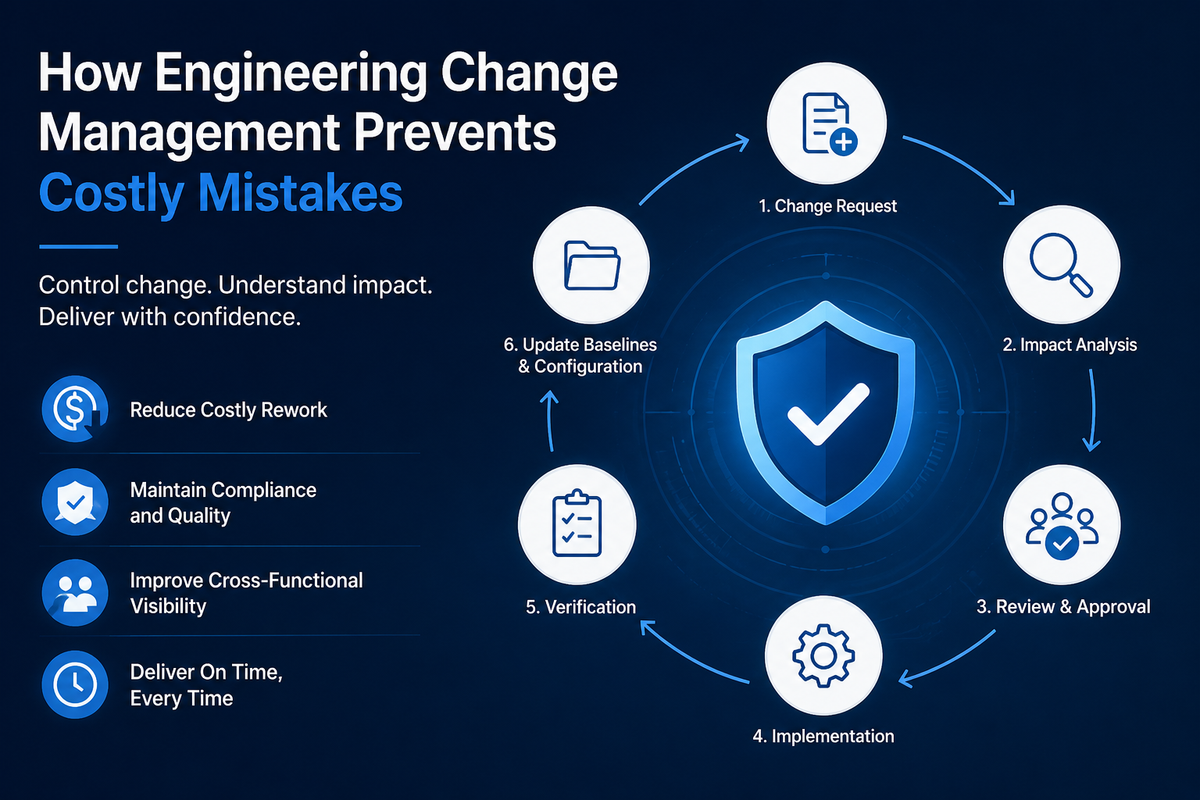
A Practical Engineering Change Workflow
A strong change management process usually follows this pattern:
- Submit the change request.
- Clarify the problem and reason for change.
- Identify affected requirements, designs, interfaces, tests, and documents.
- Perform technical, cost, schedule, risk, and verification impact analysis.
- Review the change with the right stakeholders.
- Approve, reject, or defer the change.
- Implement the change under configuration control.
- Update all affected artifacts.
- Verify the change.
- Record the final decision, evidence, and baseline update.
The process does not need to be slow. But it does need to be disciplined.
A fast uncontrolled change is not agility. It is technical debt with a deadline.
Common Pitfalls
The most common mistake is treating change management as an approval workflow instead of an engineering analysis workflow.
Approval is only useful if the decision-makers understand the impact.
Other common pitfalls include:
- Approving changes without traceability.
- Failing to update verification evidence.
- Treating baselines as static archives instead of controlled reference points.
- Allowing unofficial “working versions” to become the real source of truth.
- Reviewing documents instead of reviewing the connected engineering system.
- Underestimating small requirement changes.
- Ignoring manufacturing, support, or supplier impacts.
- Using manual spreadsheets after the system has outgrown them.
These problems are rarely dramatic at first. They accumulate quietly. Then they show up as rework, failed tests, missed requirements, supplier confusion, customer disputes, or expensive redesign.
Change Management Is Cost Control
Engineering change management prevents costly mistakes because it forces teams to slow down at the right moment: before a change is approved, implemented, released, or tested against the wrong assumptions.
It protects the team from hidden ripple effects. It protects the customer from uncontrolled variation. It protects the business from rework, delay, and avoidable risk.
Good change management does not mean saying no to change. It means saying yes with evidence.
In modern engineering, the winning teams will not be the ones that avoid change. They will be the ones that understand change faster, assess impact more accurately, and keep their technical baseline trustworthy as the system evolves.
That is the gap automated engineering tools are beginning to fill.
And that is the kind of gap Ngenaire is built to address.
References
[1] NASA, “System Engineering Handbook: Appendix — Configuration Management Process,” NASA, 2019.
[2] International Organization for Standardization, “ISO 10007:2017, Quality management — Guidelines for configuration management,” ISO, 2017.
[3] C. Bock, “Engineering Change Management Concepts for Systems Engineering,” National Institute of Standards and Technology, NIST IR 7922, 2013.
[4] A. Brahma and D. Wynn, “Concepts of change propagation analysis in engineering design,” Research in Engineering Design, 2023.
[5] E. Rebentisch, T. Schuh, M. Riesener, and G. Schuh, “Assessment of Changes in Engineering Design Using Change Propagation Cost Analysis,” Design Society, 2017.
[6] A. Goknil, I. Kurtev, and K. van den Berg, “Change impact analysis for requirements: A metamodeling approach,” Information and Software Technology, 2014.
[7] J. S. O’Neal, “Analyzing the Impact of Changing Software Requirements,” Louisiana State University, 2003.
[8] NASA, NASA Systems Engineering Handbook, Rev. 2, NASA/SP-2016-6105, 2016.
[9] C. Bock, “Engineering Change Management Concepts for Systems Engineering,” National Institute of Standards and Technology, 2013.
[10] A. Martin, “A Model-Based Approach to Analyze Change Propagation,” Procedia CIRP, 2026.