
MBSE vs Traditional Systems Engineering
Compare MBSE and document-based systems engineering across traceability, collaboration, documentation, tools, benefits, and adoption challenges.
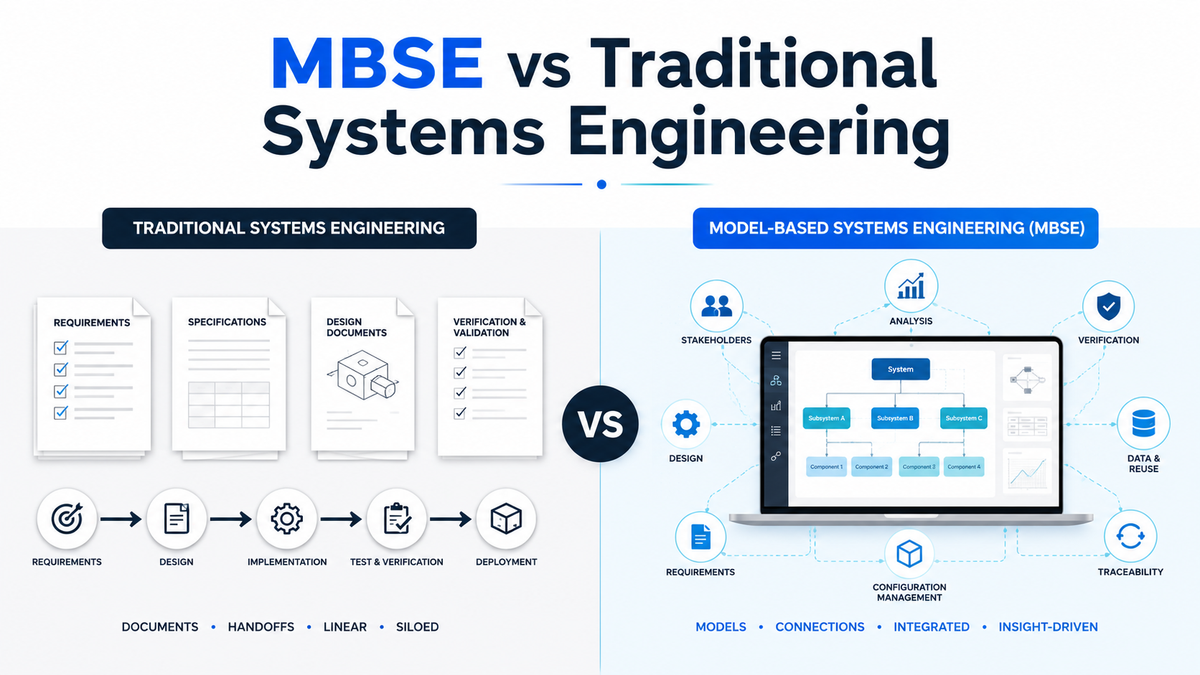
A single requirement change shouldn't take three days to trace through your program.
Yet for many engineering teams, it does.
Engineers spend hours searching through requirements specifications, interface control documents, architecture descriptions, spreadsheets, and verification plans—trying to determine what changed, what is affected, and what must be re-verified.
As systems become increasingly complex, this challenge grows exponentially.
That is the problem Model-Based Systems Engineering (MBSE) was created to solve.
Modern products are no longer purely mechanical, electrical, or software systems. Today's aerospace platforms, autonomous vehicles, medical devices, and industrial systems combine software, hardware, AI, cybersecurity, communications networks, sensors, and human-machine interfaces into tightly integrated solutions.
Traditional document-centric engineering approaches are struggling to keep pace with this complexity, leading many organizations to adopt MBSE as a cornerstone of their digital engineering strategy.
This article explores the evolution from traditional systems engineering to MBSE, the history behind the movement, the role of UML, SysML, and SysML v2, and why engineering organizations are increasingly making the transition.
A Brief History: From Documents to Models
Systems Engineering emerged as a formal discipline during the mid-20th century through large-scale aerospace, defense, telecommunications, and space programs.
Organizations such as NASA, Bell Laboratories, and major defense contractors faced an unprecedented challenge: designing systems composed of thousands of interacting components while ensuring they worked together reliably.
To manage this complexity, engineers developed structured processes centered around documentation.
Requirements specifications, interface control documents (ICDs), design descriptions, verification plans, test procedures, and operational manuals became the primary artifacts used to communicate engineering information.
This approach became known as Document-Based Systems Engineering (DBSE).
For decades, DBSE enabled remarkable achievements, including commercial aviation systems, spacecraft, telecommunications infrastructure, and military platforms.
However, as software-intensive systems became dominant during the 1980s and 1990s, the limitations of document-centric engineering became increasingly apparent.
Modern systems began exhibiting:
- Millions of lines of software code
- Hundreds of interconnected subsystems
- Rapidly evolving requirements
- Increasing cybersecurity concerns
- Complex hardware-software interactions
At this scale, document-centric approaches often produced:
- Inconsistent information across artifacts
- Traceability gaps
- Lengthy impact analysis efforts
- High documentation maintenance costs
- Increased risk of engineering errors
By the late 1990s, organizations began exploring model-centric alternatives capable of managing this growing complexity.
This movement eventually became known as Model-Based Systems Engineering (MBSE).
In 2007, the International Council on Systems Engineering formally defined MBSE as:
"The formalized application of modeling to support system requirements, design, analysis, verification, and validation activities beginning in the conceptual design phase and continuing throughout development and later lifecycle phases."
Today, MBSE is widely recognized as a foundational element of Digital Engineering initiatives across aerospace, defense, automotive, healthcare, energy, and industrial automation sectors.
Why Didn't MBSE Take Off Earlier?
One of the most interesting aspects of MBSE is that the concept itself is not new.
In fact, model-based approaches have existed for decades.
So why did widespread adoption take so long?
Several factors contributed:
Immature Tools
Early MBSE tools were often expensive, difficult to use, and lacked modern collaboration capabilities.
Limited Interoperability
Models created in one tool were often difficult or impossible to exchange with another tool.
Steep Learning Curve
Organizations needed engineers who understood both systems engineering and advanced modeling concepts.
Unclear Return on Investment
Many organizations struggled to justify the upfront investment in tools, training, and process changes.
As a result, early MBSE efforts sometimes became modeling exercises rather than engineering improvements.
Today, the landscape is changing.
Improved tooling, stronger standards, government digital engineering initiatives, and increasing system complexity have made the benefits of MBSE much easier to realize.
What is Traditional Systems Engineering?
Traditional Systems Engineering uses documents as the primary means of capturing, communicating, and managing engineering information.
A typical engineering program may store:
- Requirements in one repository
- Architecture diagrams in PowerPoint or Visio
- Interface definitions in spreadsheets
- Verification evidence in separate reports
- Design decisions across numerous documents
The engineering process itself remains sound:
- Capture stakeholder needs
- Define system requirements
- Develop system architecture
- Allocate requirements
- Design and implement subsystems
- Verify implementation
- Validate operational performance
The challenge is not the systems engineering methodology.
The challenge is managing engineering knowledge across hundreds or thousands of disconnected artifacts.
What is MBSE?
Model-Based Systems Engineering shifts the authoritative source of engineering information from documents to an integrated system model.
Instead of describing a system through hundreds of separate documents, engineers create a connected representation that captures:
- Requirements
- Functional architectures
- Physical architectures
- Interfaces
- Behaviors
- Constraints
- Verification relationships
- Design rationale
The model becomes the single source of truth.
Documentation does not disappear.
Rather, documentation becomes an output generated from the model.
This reduces duplication, improves consistency, and provides visibility into how engineering information is connected.
Most importantly:
MBSE does not replace Systems Engineering.
MBSE is a method for executing Systems Engineering more effectively.
The Role of UML, SysML, and SysML v2
UML: The Foundation
In the 1990s, software engineers developed the Unified Modeling Language (UML) to standardize software design representation.
UML introduced diagrams for:
- Class structures
- State machines
- Activities
- Sequence interactions
- Use cases
UML was highly successful for software engineering.
However, it was not designed to model complete systems involving hardware, operators, facilities, communications networks, and operational environments.
SysML: Built for Systems Engineering
To address these limitations, the Object Management Group and INCOSE collaborated to develop Systems Modeling Language (SysML).
Released in 2007, SysML extended UML with capabilities specifically designed for systems engineering.
Key additions included:
- Requirement diagrams
- Parametric analysis
- Allocation relationships
- Functional decomposition
- Support for hardware and software architectures
- Representation of people, processes, and facilities
SysML rapidly became the dominant language for MBSE implementations.
Today, it remains the most widely used systems modeling language in industry.
SysML v2: The Next Generation
Although SysML v1 enabled significant advances, it also introduced challenges.
Common complaints included:
- Complex notation
- Tool interoperability issues
- Difficulty exchanging models
- Limited automation capabilities
To address these limitations, OMG and INCOSE developed SysML v2.
SysML v2 introduces:
- Cleaner and more precise semantics
- Improved usability
- Standardized APIs
- Enhanced interoperability
- Better automation support
- Improved textual modeling capabilities
Perhaps most importantly, SysML v2 helps establish the foundation for a connected Digital Engineering ecosystem where engineering information can flow seamlessly between tools.
Many organizations view SysML v2 as a major step toward realizing the full vision of MBSE.
Traditional Systems Engineering vs MBSE
A Simple Example
Consider a requirement for an unmanned aircraft system:
The system shall detect and track a Class 1 drone at a range of 3 km.
If that requirement changes to 5 km, numerous engineering artifacts may be affected:
- Sensor performance requirements
- Detection algorithms
- Processing hardware
- Power budgets
- Verification procedures
- Operational concepts
In a document-centric environment, engineers may spend days identifying all affected artifacts.
In an MBSE environment, those relationships are explicitly represented within the model, allowing engineers to quickly identify downstream impacts and make informed decisions.
This is where much of MBSE's value is realized.
Why Organizations Are Adopting MBSE
Increasing Software Content
Modern systems contain millions of lines of software interacting with hardware in real time.
Managing these relationships through documents alone creates significant risk.
Digital Engineering Initiatives
Governments and prime contractors increasingly expect engineering data to be digitally connected and traceable.
Faster Development Cycles
Organizations need to identify problems earlier and reduce costly late-stage redesign efforts.
Improved Collaboration
Mechanical, electrical, software, systems, manufacturing, and test engineers can work from a common representation of the system.
Foundation for Digital Twins
Many Digital Twin initiatives depend upon the structured system information produced through MBSE.
MBSE and the Digital Thread
Closely related to MBSE is the concept of the Digital Thread.
A Digital Thread connects engineering information across the entire lifecycle of a system—from requirements and design through manufacturing, testing, operations, and sustainment.
MBSE often serves as the backbone of this Digital Thread by creating structured relationships between engineering artifacts.
Rather than information existing in isolated repositories, the Digital Thread enables stakeholders to trace decisions, requirements, and performance data across the lifecycle.
MBSE and Artificial Intelligence
Artificial Intelligence is poised to significantly accelerate MBSE adoption.
Traditional AI systems struggle with disconnected engineering documents because context is fragmented and relationships are often implicit.
System models provide something much more valuable:
Structured engineering knowledge.
Emerging AI-enabled engineering tools can:
- Generate draft requirements
- Identify traceability gaps
- Detect inconsistencies
- Recommend architectures
- Assist with verification planning
- Answer engineering questions directly from system models
As organizations adopt MBSE and SysML v2, AI systems will gain access to richer and more connected engineering data.
The combination of AI and MBSE has the potential to dramatically reduce engineering busywork while improving decision quality.
MBSE Is Not a Silver Bullet
A common misconception is that purchasing a modeling tool automatically improves engineering performance.
It does not.
MBSE does not replace:
- Good requirements engineering
- Effective architecture development
- Verification and validation planning
- Risk management
- Technical leadership
Organizations that struggle with systems engineering fundamentals will often carry those same challenges into their models.
Successful MBSE adoption requires:
- Skilled systems engineers
- Effective processes
- Governance standards
- Training
- Organizational commitment
The benefits are substantial, but they require disciplined execution.
Looking Ahead
The engineering industry is moving toward a future where requirements, architectures, simulations, verification evidence, operational data, and AI-assisted analysis are connected through an unbroken Digital Thread.
Traditional documents will not disappear.
Regulated industries will continue to require specifications, plans, reports, and certification evidence.
However, the role of documentation is changing.
Rather than serving as the primary repository of engineering knowledge, documents are increasingly becoming outputs generated from authoritative system models.
The organizations that gain the greatest value from MBSE are not necessarily the ones with the largest models.
They are the ones that use models to make better engineering decisions.
As systems become increasingly software-defined, connected, autonomous, and AI-enabled, engineering teams must move beyond managing documents and begin managing knowledge.
MBSE is ultimately about making that knowledge visible, connected, and actionable.
The future is not documents versus models.
It is models as the foundation, and documents as the product.
References
- Estefan, J. A. (2008). Survey of Model-Based Systems Engineering (MBSE) Methodologies. Jet Propulsion Laboratory, California Institute of Technology.
- Wymore, A. W. (1993). Model-Based Systems Engineering. CRC Press.
- Friedenthal, S., Moore, A., & Steiner, R. (2015). A Practical Guide to SysML: The Systems Modeling Language (3rd Edition). Morgan Kaufmann.
- Holt, J., & Perry, S. (2019). SysML for Systems Engineering (2nd Edition). Institution of Engineering and Technology.
- Madni, A. M., & Sievers, M. (2018). "Model-Based Systems Engineering: Motivation, Current Status, and Research Opportunities." Systems Engineering, 21(3), 172–190.
- INCOSE. (2023). Systems Engineering Handbook (5th Edition).
- U.S. Department of Defense. (2018). Digital Engineering Strategy.
- OMG. (2024). SysML v1.7 Specification.
- OMG. (2025). SysML v2 Specification.