
What Happens When You Change One Requirement? More Than You Think.
A one-line requirement change can ripple through architecture, software, hardware, safety, verification, schedule, and cost. Here’s why traceability matters.
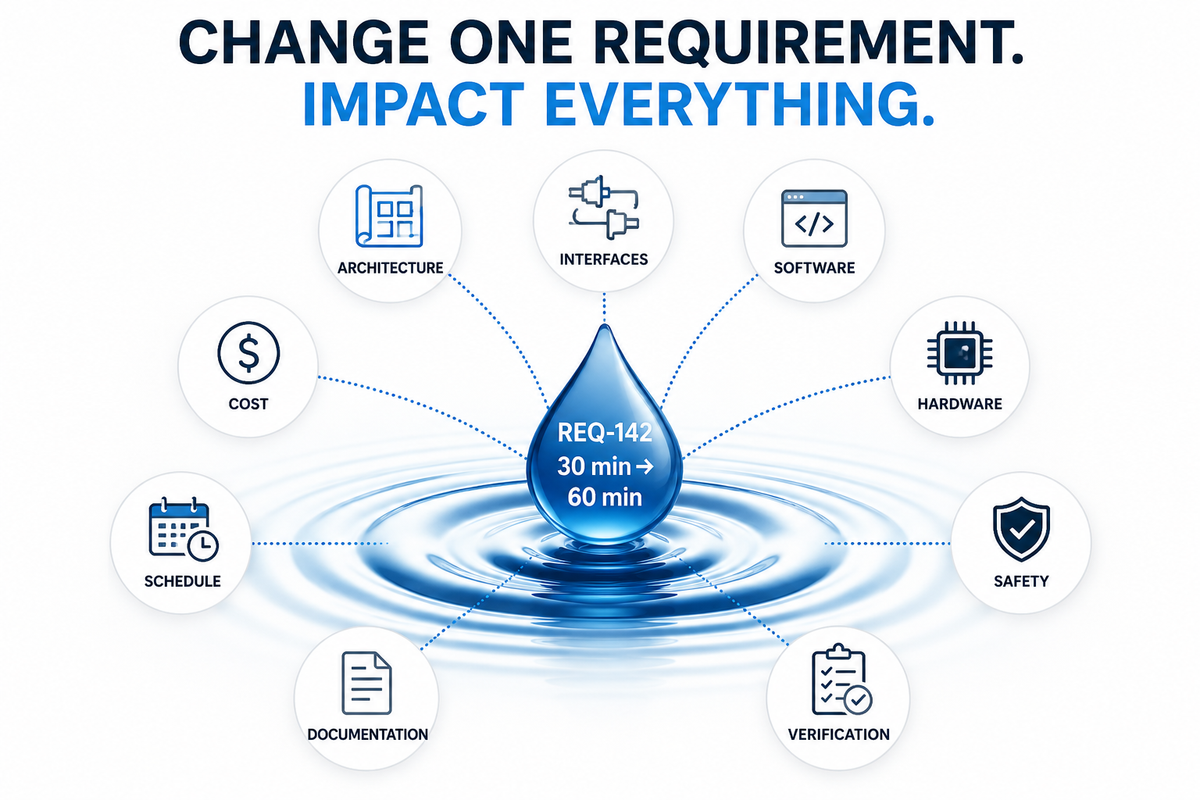
“Can we make it one hour instead of 30 minutes?”
Sounds small.
Imagine an industrial system with this requirement:
REQ-142: The system shall continue normal operation for at least 30 minutes following loss of external power.
A customer asks for 60 minutes.
Someone changes “30” to “60.”
One sentence. One number.
The engineering impact is anything but small.
The Battery Is Only the First Domino
The obvious answer is a larger battery.
But that can change mass, volume, mounting, charging time, heat generation, service access, and enclosure layout.
If the existing charger cannot support it, the power architecture changes too.
Now electrical, mechanical, thermal, procurement, and manufacturing may all have work.
And we have only followed the first link.
Then the Interfaces Move
Suppose the battery-management system reports state of charge to the main controller.
Does the interface support the new battery?
Does software estimate remaining runtime using assumptions based on the old capacity?
Are alarm thresholds still valid?
Does the user interface still display meaningful time-to-shutdown?
If the system sends backup-power status to external equipment, the change may have already crossed the system boundary.
SEBoK treats requirements management as a lifecycle activity involving change, interfaces, bidirectional traceability, verification artifacts, resources, and schedule—not simply maintaining a specification [1].
Software Gets Pulled In Too
Perhaps the controller sheds non-essential loads after 20 minutes, preserving the final 10 minutes for controlled shutdown.
What happens now?
Keep 20 minutes?
Change it to 50?
Introduce multiple power-saving states?
Are those values hard-coded?
Do diagnostics assume the old battery capacity?
“Use a bigger battery” just became a software behaviour change.
Then Somebody Asks the Safety Question
More stored energy can change fault consequences.
Does the hazard analysis still hold?
Are thermal cases different?
Is the existing protection strategy still adequate?
Do maintenance procedures need updating?
NASA's software engineering guidance explicitly says requirement-change impact analysis should consider architecture, interfaces, hardware, safety, reliability, performance, rework, testing, documentation, cost, and schedule [2].
That is the real size of the change.
Verification Inherits It
The old test ran for 30 minutes after external power was removed.
Now it runs for 60.
Except perhaps backup duration varies with temperature, battery age, operating mode, or peak load.
Suddenly the team may need new test conditions, updated procedures, revised acceptance criteria, and additional regression testing because the power-state software changed.
The RVTM, verification plan, and test reports all need review.
Meanwhile, the replacement battery has a lead time.
A new bracket needs a drawing release.
Software needs implementation.
Safety needs review.
Testing needs another slot.
The requirement changed in five seconds.
The schedule did not.
This Is What a Digital Thread Is Actually For
The practical value of a digital thread is remarkably simple:
When something changes, you can see what it touches.
NIST describes the digital thread as an authoritative, integrated information flow connecting phases of the product lifecycle and notes that persistent identifiers for engineering requirements help organizations track related information throughout a product's life [3].
The U.S. Department of Defense similarly describes digital engineering as using authoritative system data and models continuously across disciplines and lifecycle activities [4].
For REQ-142, the useful question is no longer just:
“What does the requirement say?”
It becomes:
- What stakeholder need drove it?
- Which architecture elements and interfaces depend on it?
- Which software and hardware implement it?
- Which risks or hazards are connected?
- Which tests prove compliance?
- Which documents and baselines contain the old value?
- Which activities and milestones are now affected?
If those relationships live in disconnected documents and people's memories, impact analysis becomes a meeting.
If they are connected, impact analysis becomes engineering.
Where Ngenaire Fits
This is exactly the kind of problem Ngenaire is designed to expose.
Within Ngenaire, requirements can be connected to their hierarchy, diagrams, risks, SOW content, and verification artifacts.
Its Network View lets an engineer start from a changed requirement and explore connected dependencies.
When requirements change, dependent links can also be marked as suspect, forcing the team to deliberately review whether those relationships are still valid [5].
That changes the conversation around REQ-142.
Instead of:
“Does anyone know what else uses this requirement?”
The team can start asking:
“Show me what this change affects.”
The point is not to prevent change.
Change is normal.
The point is to understand the change before approving it.
A one-line requirement should never create a six-month surprise because nobody could see the thread connecting it to the rest of the system.
The dangerous requirement change is rarely the one that looks large.
It is the one everyone thinks is small.
References
[1] T. Katz, L. Wheatcraft, and M. Ryan, “Requirements Management,” Systems Engineering Body of Knowledge (SEBoK), ver. 2.14, May 2026.
https://sebokwiki.org/wiki/Requirements_Management
[2] NASA, “SWE-053 — Manage Requirements Changes” and “SWE-080 — Track and Evaluate Changes,” NASA Software Engineering Handbook.
https://swehb.nasa.gov/spaces/SWEHBVD/pages/102695435/SWE-053+-+Manage+Requirements+Changes
[3] T. Thurman, A. Trainer, A. B. Feeney, R. Astheimer, M. Hardwick, and M. Hedlind, “Research Results and Recommendations for Universally Unique Identifiers in Product Data Standards,” NIST Advanced Manufacturing Series 300-12, Jul. 2024, doi: 10.6028/NIST.AMS.300-12.
https://www.nist.gov/publications/research-results-and-recommendations-universally-unique-identifiers-product-data
[4] U.S. Department of Defense, Digital Engineering Strategy, Office of the Deputy Assistant Secretary of Defense for Systems Engineering, Jun. 2018.
https://ac.cto.mil/wp-content/uploads/2019/06/2018-Digital-Engineering-Strategy_Approved_PrintVersion.pdf
[5] Ngenaire, “Traceability” and “Requirements: EARS Patterns, Quality, and Management,” Ngenaire Documentation, accessed Sep. 2, 2026.
https://ngenaire.com/docs/concepts/traceability