
The Requirements Document Nobody Trusts Anymore
The specification is approved, but the design has moved on. Explore how outdated requirements, conflicting versions and tribal knowledge cause engineers to bypass the document—and what it takes to make the technical baseline trustworthy again.
At 9:06 on a Tuesday morning, a design review stops on one sentence.
The requirement says the system shall enter its safe state within five seconds of losing communication.
The software lead looks at it and frowns.
“We changed that to eight seconds.”
The systems engineer opens the approved specification. Five seconds.
Someone else pulls up a change request. Eight seconds—but the request is still marked pending.
The test lead has a procedure built around six seconds because that is what the prototype actually does. The interface document does not mention the timing at all. Then a senior engineer, who has been quiet until now, says the sentence that settles the matter:
“Ask Daniel. He knows what we agreed.”
Daniel is on vacation.
The meeting moves on.
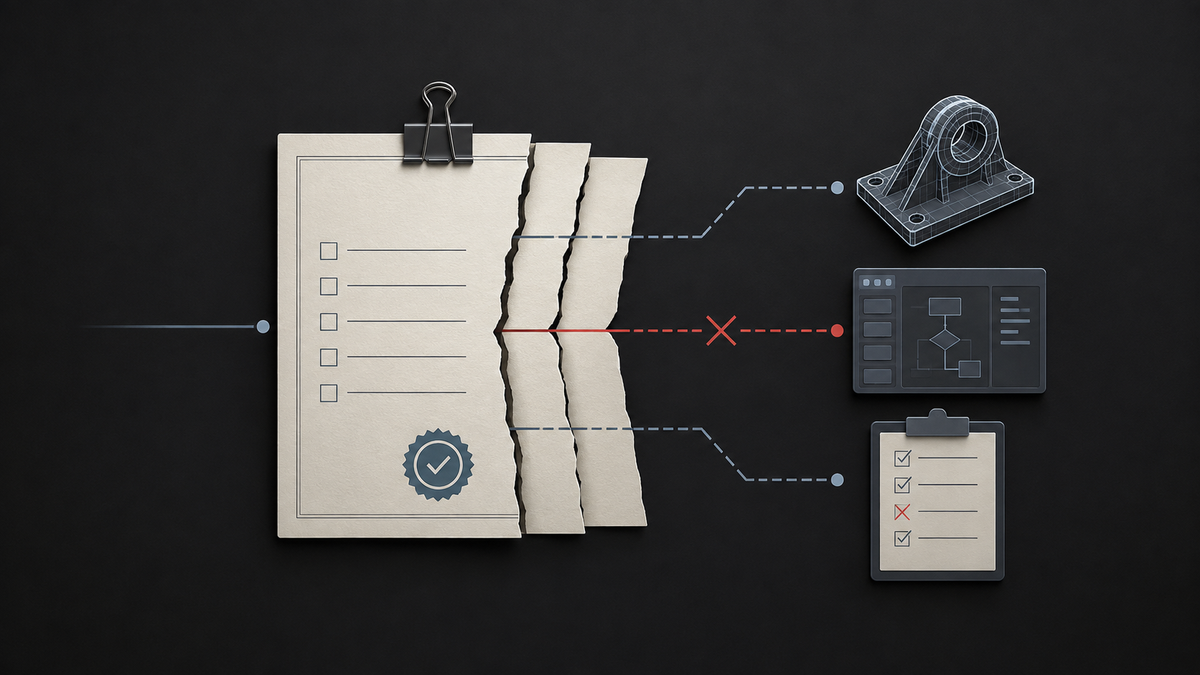
Most experienced engineers recognize some version of this scene. The names, numbers and documents change, but the pattern does not. There is an approved specification. There is an actual design. And somewhere between them is a trail of decisions that only a few people can reconstruct.
The requirements document still exists. It still has a revision number. It may even have all the right signatures.
But nobody trusts it anymore.
Trust rarely disappears all at once
A requirements document does not usually become irrelevant because of one dramatic failure. It happens through dozens of reasonable decisions made under pressure.
A supplier cannot meet a tolerance, so the team accepts an alternative.
A prototype reveals that a response time is unrealistic, so software adjusts it.
A customer clarifies an operating scenario during a call, but the meeting notes never become a change request.
A test engineer discovers that the requirement cannot be verified as written and quietly makes the procedure more practical.
An interface value changes in a model, then in code, then in a test script—but not in the specification.
Each individual decision may be technically sound. The problem is that the decisions do not arrive everywhere they need to arrive. The design moves. The document stays still.
This is why “outdated documentation” understates the problem. An old document is inconvenient. An untrusted document changes how an engineering organization behaves.
Once people stop believing the specification, they build their own routes to the truth.
- Software trusts the code and backlog.
- Test trusts the latest procedure and what passed on the bench.
- Mechanical trusts the released drawing.
- Manufacturing trusts the work instruction.
- Project management trusts the last review deck.
- The customer trusts the contract.
- The most experienced engineers trust their memory.
Every group has evidence. None has the complete picture.
The unofficial specification begins to take over
At first, bypassing the document feels efficient.
Why spend twenty minutes searching a requirements database when Priya can answer the question in thirty seconds? Why raise a formal change when everyone in the room already agrees? Why wait for the specification to catch up when the design team has a deadline on Friday?
These shortcuts often keep work moving. That is exactly why they spread.
Soon, the project has two systems of record:
- The controlled baseline used for reviews, contracts and compliance.
- The working truth used to build the product.
Then a third appears: the explanations, exceptions and assumptions carried in people’s heads.
The official document describes what the system was once expected to be. The design artifacts describe pieces of what it has become. Tribal knowledge explains the difference.
That arrangement can survive for a surprisingly long time—especially when the same experienced people remain on the project. They become the integration layer. They remember why a threshold moved, which interface field is obsolete, what the customer “really meant,” and which requirement should not be interpreted literally.
But the apparent stability is borrowed from those individuals. When one of them changes roles, leaves the company or simply forgets a detail, the project discovers that it did not preserve its engineering knowledge. It preserved access to someone who had it.
Research on traceability makes this distinction explicit. It is not enough to link a requirement forward to code or a test. Teams also need to preserve where the requirement came from: stakeholder interviews, meeting records, legacy systems and design decisions. Without that upstream context, basic questions such as Why does this requirement exist?, Why did it change? and Who was involved? become difficult to answer [1].
That missing context is where tribal knowledge grows.
Engineers do not ignore specifications because they are careless
They ignore specifications when experience teaches them that the specification is slower and less accurate than the alternatives.
Trust is an engineering calculation, even when nobody calls it one.
If a document repeatedly gives the wrong answer, requires a second source to confirm it, or hides the rationale needed to interpret it, people learn to route around it. The same way an operator stops trusting an alarm that constantly produces false positives, an engineer stops trusting a requirement that is routinely superseded by hallway conversations and redlined PDFs.
This is not primarily a discipline problem. It is a feedback problem.
The team makes a decision, but the decision does not reliably update the baseline. The baseline therefore becomes less useful. Because it is less useful, fewer people consult it. Because fewer people consult it, errors remain undiscovered. Because the errors remain, trust falls further.
The document enters a slow death spiral.
Formal guidance is clear about what should happen instead. NASA’s systems engineering handbook calls for consistency among requirements, the concept of operations, architecture and design. It also calls for bidirectional traceability across stakeholder expectations, product requirements, design documents, and test plans and procedures [2]. Approved changes are supposed to be communicated promptly, with actions to update affected documentation tracked to completion [2].
That sounds obvious. In practice, it is where many workflows break.
The change is approved in one place. The requirement is stored in another. The design lives somewhere else. Verification evidence arrives months later. Updating the ecosystem depends on somebody remembering every affected artifact—and having enough time to edit each one.
The damage appears at the worst possible moments
During normal development, an untrusted specification creates friction. During a major review, integration event, audit, supplier dispute or failure investigation, it becomes a liability.
Reviews become theatre
The team presents a polished requirements baseline while quietly relying on newer information outside it. Reviewers ask whether the design meets the requirements, and engineers answer from memory because the trace links are incomplete.
The review may still pass. The uncertainty is simply carried forward.
Impact analysis becomes guesswork
A requirement changes. Which interfaces are affected? Which risks need to be reopened? Which drawings, models, software components and tests now need revision?
Without dependable links, impact analysis becomes a meeting invitation sent to everyone who might know. If the right expert is absent, the analysis has a blind spot.
Verification loses its foundation
Verification asks whether the implemented system satisfies its requirements. But which version of the requirement? Was the test procedure written against the current threshold? Was a waiver approved? Does the pass result still mean what the report says it means?
A green test result is not reassuring if it is tied to the wrong baseline.
Onboarding becomes oral history
New engineers read the specification and then spend weeks learning which parts not to trust. They are handed a map and immediately told that several roads no longer exist.
This creates a peculiar penalty: the more diligently a new engineer follows the controlled documentation, the more likely they are to make an outdated decision.
The organization becomes dependent on memory
The people with the most historical knowledge become bottlenecks. They are pulled into every review, every anomaly and every interface discussion—not necessarily because they own the work, but because they can translate between the official system and the real one.
An international survey of 228 organizations found that incomplete or hidden requirements, communication flaws and moving targets were among the most frequently cited requirements-engineering problems and among those most associated with project failure [3]. Those are often treated as separate issues. On a live project, they reinforce one another: weak communication creates hidden decisions; hidden decisions create inconsistent requirements; inconsistency makes change harder to control.
A signed document is not automatically an authoritative one
Configuration control matters. A baseline should identify what has been formally reviewed and agreed at a point in time, and changes to it should follow an intentional control process [4]. But approval alone does not make information trustworthy forever.
Authority has to be maintained.
That requires more than storing a PDF in a controlled folder. The U.S. Department of Defense’s Digital Engineering Strategy describes an authoritative source of truth as a governed environment for sharing models, data and digital artifacts across the lifecycle. It is intended to support the technical baseline, reviews and decision-making—not merely archive documents after decisions have already happened [5].
The wording matters. The objective is not one enormous file that contains everything. Modern systems are too complex for that. Requirements, architecture, interfaces, analysis, risk, verification and configuration data may live in different forms.
What matters is that the authoritative sources are connected, governed and current enough that an engineer can follow a decision across them.
If requirement SYS-142 changes, the team should be able to see what drove the change, who approved it, which architecture elements implement it, which interfaces it touches, which risks it alters and which tests provide evidence of compliance.
The document can still exist. It becomes a controlled view of live engineering information rather than a manually reconstructed snapshot of it.
How do you make the specification trustworthy again?
Not with a documentation clean-up week.
Those exercises can fix visible errors, but they do not repair the process that created them. Three months later, the same drift returns.
Restoring trust requires changing how engineering decisions move.
1. Name the authoritative baseline—and make its status obvious
Every engineer should know where to find the current approved requirement, who owns it and whether a proposed change is pending.
“It is somewhere on the shared drive” is not configuration management.
The baseline also needs history. Effective configuration status accounting preserves current and historical configuration information, not just the latest file [2]. A team should be able to reconstruct what was true at a previous release without relying on filenames such as FINAL_v7_REALLY_FINAL.pdf.
2. Connect requirements to the work they govern
Traceability should answer real engineering questions:
- What stakeholder need or operational scenario produced this requirement?
- What lower-level requirements and design elements satisfy it?
- Which interfaces depend on it?
- How will it be verified?
- What evidence shows that verification occurred?
- What else changes if this requirement changes?
Traceability is often disliked because teams experience it as administrative link maintenance. That reaction is understandable. Research has repeatedly identified the effort and cost of traceability as barriers to adoption [1], [6]. The answer is not to abandon traceability; it is to design it around decisions engineers actually need to make and automate the clerical work wherever possible.
3. Capture the reason, not just the result
“Threshold changed from 5 to 8 seconds” records an edit.
“Threshold changed after network-loss testing showed that five seconds caused unnecessary safe-state transitions under expected latency; approved by X after impact review of Y and Z” preserves engineering knowledge.
Rationale, assumptions, alternatives and approval context are not optional decoration. They are what allow a future engineer to determine whether the decision still applies.
4. Make the controlled path easier than the workaround
If raising and approving a small requirement change takes three weeks, teams will continue making decisions outside the system.
Governance should be proportional. High-impact changes need rigorous review. Low-risk corrections still need history and ownership, but they should not require an obstacle course.
The goal is not maximum process. It is a change path fast enough that engineers will actually use it.
5. Treat conflict as a signal, not an embarrassment
When a requirement conflicts with a model, interface or test, the team has found valuable information. Hiding the inconsistency until the next formal review only allows it to become more expensive.
A healthy system should surface conflicting values, missing links, stale verification methods, unresolved changes and orphaned requirements early—while the people who understand the decision are still available.
Where Ngenaire fits
This is the problem Ngenaire is built to address: not simply writing better requirements, but helping engineering teams keep requirements connected to the system being designed, changed and verified.
Within Ngenaire, requirements can be managed alongside the artifacts that give them meaning—stakeholder needs, CONOPS, architecture and SysML/UML views, interfaces, risks, change records, verification plans, procedures, reports and traceability matrices. A network view helps teams see how those artifacts relate rather than treating each document as an isolated deliverable.
That connected structure matters when something changes. Instead of asking the team to remember every downstream effect, Ngenaire can support impact analysis across linked artifacts, flag quality and consistency issues, and help generate updated engineering outputs from controlled information. Baselines, access rights and engineering change workflows help preserve who changed what, why it changed and what was approved.
AI can reduce the effort required to find inconsistencies, identify missing relationships, examine requirement quality and prepare documentation. But it should not become an invisible authority that rewrites the baseline on its own. Engineers still own technical judgment, approvals and configuration decisions.
The useful role of AI is to make disciplined engineering easier to sustain—especially the repetitive checking and document maintenance that teams are most likely to postpone under schedule pressure.
Because the real objective is not a more impressive requirements document.
It is a requirements system that remains credible while the design evolves.
The question every team should ask
When an engineer needs to know what the system must do, where do they look first?
If the honest answer is a person’s name, a private spreadsheet, an old email thread or “whichever document was updated last,” then the requirements problem is already larger than document quality.
The specification has stopped functioning as a shared engineering agreement.
And once that agreement is gone, every design decision takes a little longer. Every review carries a little more uncertainty. Every change depends a little more on memory.
The document nobody trusts is not harmless paperwork sitting on a server.
It is a warning that the project’s technical truth has fragmented.
The longer a team waits to reconnect it, the more expensive that truth becomes to recover.
When did your team last use a requirement to answer a real engineering question—without having to ask someone whether it was still correct?
References
[1] J. Mucha, A. Kaufmann, and D. Riehle, “A systematic literature review of pre-requirements specification traceability,” Requirements Engineering, vol. 29, pp. 119–141, 2024, doi: 10.1007/s00766-023-00412-z.
[2] National Aeronautics and Space Administration, NASA Systems Engineering Handbook, Rev. 2, NASA/SP-2016-6105, Washington, DC, 2016. [Online]. Available: NASA Systems Engineering Handbook. [Accessed: Aug. 14, 2026].
[3] D. Méndez Fernández et al., “Naming the pain in requirements engineering: Contemporary problems, causes, and effects in practice,” Empirical Software Engineering, vol. 22, no. 5, pp. 2298–2338, 2017, doi: 10.1007/s10664-016-9451-7.
[4] L. A. Johnson, K. Dempsey, R. Ross, S. Gupta, and D. Bailey, Guide for Security-Focused Configuration Management of Information Systems, NIST Special Publication 800-128, updated Oct. 2019. doi: 10.6028/NIST.SP.800-128.
[5] Office of the Deputy Assistant Secretary of Defense for Systems Engineering, Department of Defense Digital Engineering Strategy, Washington, DC, Jun. 2018. [Online]. Available: DoD Digital Engineering Strategy. [Accessed: Aug. 14, 2026].
[6] R. Torkar, T. Gorschek, R. Feldt, M. Svahnberg, U. A. Raja, and K. Kamran, “Requirements traceability: A systematic review and industry case study,” International Journal of Software Engineering and Knowledge Engineering, vol. 22, no. 3, pp. 385–433, 2012, doi: 10.1142/S021819401250009X.